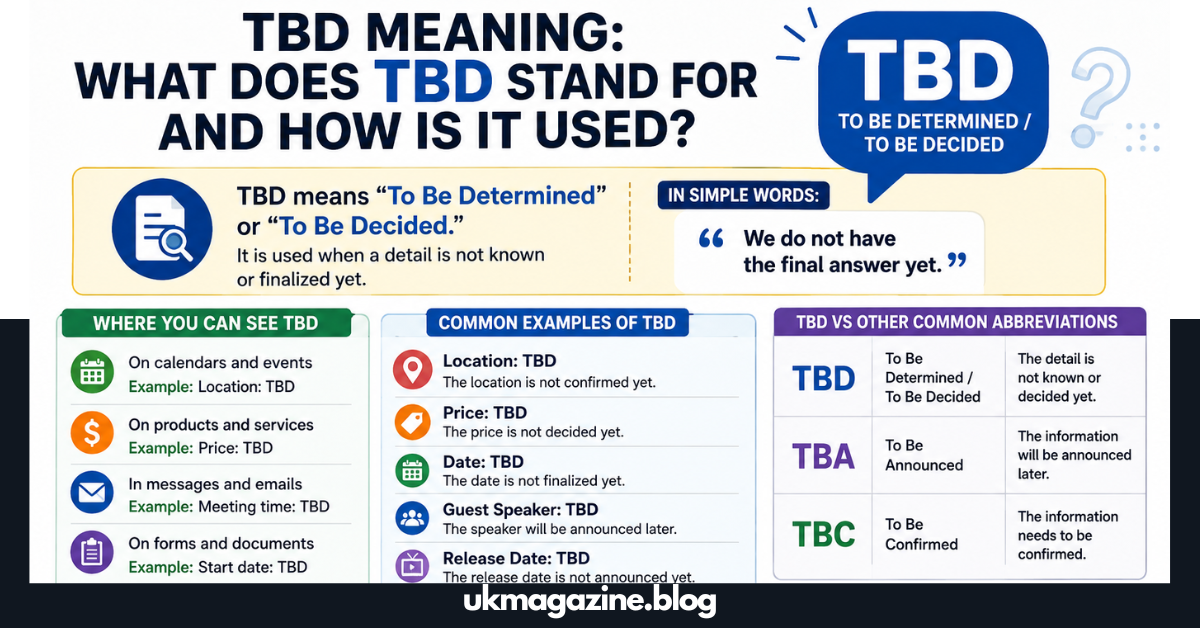
If you have seen TBD on a calendar, message, website, form, or event page, you may wonder what it means. The TBD meaning is usually “To Be Determined” or “To Be Decided.” It tells you that a detail is not known or finalized yet. Cambridge Dictionary defines TBD as a written abbreviation used when something has not yet been decided or is not yet known. Oxford gives a similar meaning and shows examples such as release dates and prices that are still undecided.
For example, you might see “Location: TBD” on an event page. This means the organizers have not chosen or confirmed the location yet. You may also see “Price: TBD,” which means the final price has not been decided. In simple words, TBD is a short way to say, “We do not have the final answer yet.” It is common in everyday communication, business, school, sports, entertainment, technology, and event planning.
TBD Full Form
The most common TBD full form is To Be Determined. It can also mean To Be Decided, depending on the sentence and situation. Both expressions communicate almost the same idea. Merriam-Webster lists TBD as an abbreviation for “to be determined,” while Cambridge includes both “to be decided” and “to be determined.”
The phrase is useful because it saves space. Instead of writing “The date has not been decided yet,” a person can simply write “Date: TBD.” This makes schedules, forms, project plans, and online listings easier to read. You should not normally think of TBD as a final answer. It is a placeholder that shows a decision is still pending. Once the missing information becomes available, TBD should be replaced with the actual information. For example, “Meeting Room: TBD” could later become “Meeting Room: 204.” The abbreviation is usually written in capital letters, although lowercase “tbd” is also accepted.
TBD Meaning in Simple English
In very simple English, the TBD meaning is “not decided yet.” Imagine that your friends want to have a party. Everyone agrees that the party will happen, but nobody has chosen the place. You could write, “Party location: TBD.” This tells everyone that the location will be shared after a decision is made.
TBD does not always mean that something will happen. It simply means that a particular detail is not final at that moment. For example, a company may list a product with “Release Date: TBD.” The company may still be working on the launch schedule. A sports website may show “Opponent: TBD” because the opponent depends on an earlier match. A school may show “Exam Room: TBD” because rooms have not been assigned. This simple abbreviation helps readers understand that information is incomplete without making the sentence long or confusing.
TBD Meaning in Texting and Chat
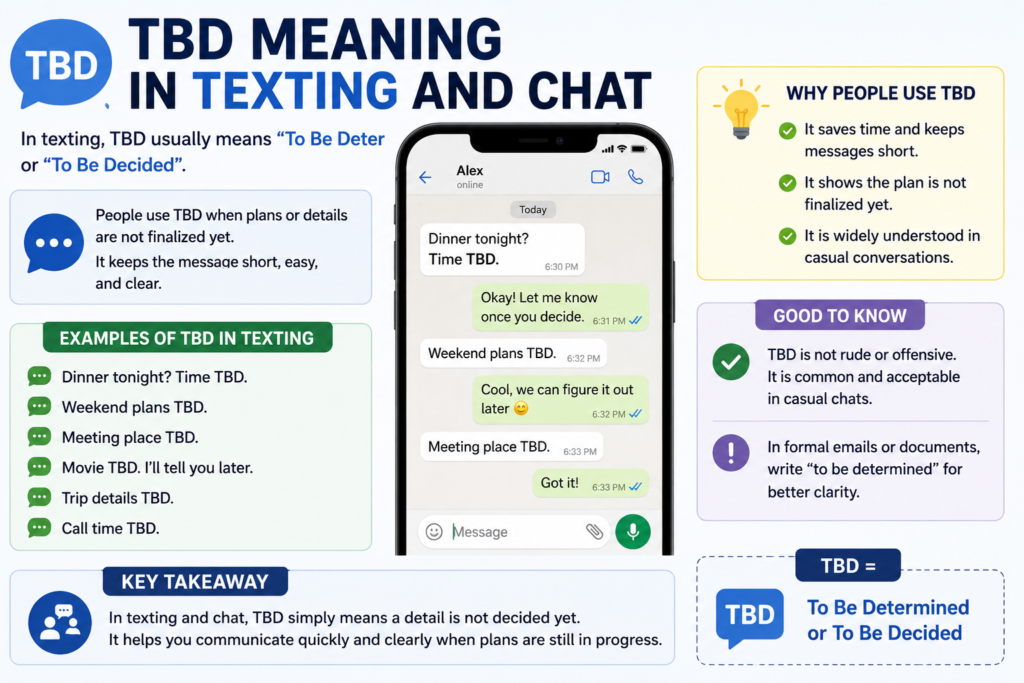
The TBD meaning in texting is usually the same as its formal meaning: To Be Determined or To Be Decided. People often use it when talking about plans that are not finalized. For example, someone might text, “Dinner tonight? Time TBD.” This means the person has not decided the exact time yet.
You may also see phrases such as “Weekend plans TBD,” “Meeting place TBD,” or “Movie TBD.” In casual chat, TBD can make a message quick and clear. It is especially useful when people know that something may happen but still need to decide an important detail. The abbreviation is not considered rude or offensive. However, it may sound too informal for some professional documents. In a formal email, you can write “to be determined” if your reader may not know the abbreviation. When chatting with friends, coworkers, or online communities, simply writing “TBD” is usually easy to understand.
TBD Examples in Everyday Life
There are many simple examples of TBD in everyday communication. You might see “Dinner time: TBD” when friends have not selected a time. A travel plan could say “Hotel: TBD” when the traveler has not booked accommodation. A school notice might say “Classroom: TBD” while the administration is still arranging rooms.
Here is a detailed table showing how TBD can appear in different situations:
| Situation | Example | What It Means |
| Event | Venue: TBD | The venue is not decided |
| Meeting | Time: TBD | The meeting time is not final |
| Travel | Hotel: TBD | The hotel has not been selected |
| School | Room: TBD | The room has not been assigned |
| Work | Deadline: TBD | The final deadline is not decided |
| Product | Price: TBD | The final price is unknown |
| Gaming | Release Date: TBD | The release date is not final |
| Sports | Opponent: TBD | The opponent is not known yet |
| Movies | Cast: TBD | The cast detail is not finalized |
| Shopping | Restock: TBD | The restock date is unknown |
| Jobs | Start Date: TBD | The starting date is not decided |
| Projects | Budget: TBD | The budget needs a final decision |
These examples show why TBD is useful. It clearly marks information that still needs an answer.
TBD Meaning in Business and Work
In business, the TBD meaning is often connected with information that is still being planned or approved. Companies may use TBD in project documents, meeting schedules, budgets, product plans, job descriptions, and presentations. For example, a project manager could write “Launch Date: TBD” while teams are checking whether the product is ready.
TBD can also appear beside costs, responsibilities, locations, or deadlines. It does not necessarily mean that the project has a problem. It may simply mean that the team needs more information before making a final choice. For example, a company may know that it wants to hold a conference but still need to choose a venue. The event can be listed as “Venue: TBD” until the contract is signed. In project management, this helps teams identify open decisions. However, leaving too many items as TBD for too long can create confusion. Good teams should review these items and update them when decisions are made.
TBD Meaning for Events and Schedules
The TBD meaning is especially common in event planning. Concerts, conferences, weddings, sports events, school activities, and public programs often have details that are announced at different times. An event may have a confirmed date but an undecided venue. In that case, organizers can write “Venue: TBD.”
For example, imagine a conference scheduled for October 15. The organizers know the date, but they are still comparing two hotels. Their event page could show “Location: TBD.” This tells visitors that the event is planned but the location has not been finalized. Cambridge gives a similar example where an event has a known date but its location remains TBD.
TBD is helpful because it avoids giving people incorrect information. It is better to say that a location is TBD than to publish a location that may later change. Once the organizers make the final decision, they should replace TBD with the confirmed details.
TBD Meaning in Sports
Sports websites and schedules also use TBD quite often. The TBD meaning in sports usually tells fans that a team, opponent, time, or location has not been finalized. This can happen when a tournament uses knockout rounds.
For example, a quarterfinal schedule may say “Team A vs. TBD.” This means Team A has already qualified, but the other team will be known after another match. A tournament can also show “Final Time: TBD” when organizers have not selected the exact starting time.
The abbreviation can therefore be connected to future results rather than missing information caused by an error. The information may become available naturally as games are played. This is why you might see TBD on tournament brackets, playoff schedules, championship pages, and sports event listings. When the result or schedule becomes certain, the website can replace TBD with the correct team, time, or location.
TBD Meaning in School and Education
Students can also encounter TBD in school, college, and university information. The TBD meaning remains the same, but the missing detail may relate to classes, rooms, teachers, exam schedules, assignments, or course information.
For example, a course timetable could show “Room: TBD.” This means the school has not assigned a classroom yet. An exam schedule might say “Time: TBD” if the final exam time is still being arranged. A course listing could also show “Instructor: TBD” when the school has not assigned a teacher.
Seeing TBD does not automatically mean that something is canceled. It usually means that the information is still pending. Students should check the official school portal or notice later for updates. If the information is important, contacting the school office can also help. This is one reason schools use placeholders carefully: students need to know which details are confirmed and which ones may change.
TBD vs TBA: What Is the Difference?
Many people confuse TBD and TBA because both are used for future information. The main TBD meaning is that something has not been decided or determined yet. TBA usually means “To Be Announced.” It often suggests that information will be shared publicly later.
For example, imagine a concert where the organizer has not chosen the opening performer. “Opening Act: TBD” would suggest that the choice is still being made. If the performer has already been selected but the organizer has not announced the name, “Opening Act: TBA” may be more suitable.
The difference can be small in everyday use, and people sometimes use the terms loosely. However, remembering the basic idea makes them easier to understand. TBD = the decision is still pending. TBA = the information will be announced later. This simple rule works well for most everyday situations.
| Term | Full Form | Basic Meaning | Example |
| TBD | To Be Determined | Not decided yet | Venue: TBD |
| TBA | To Be Announced | Information will be announced | Speaker: TBA |
| TBC | To Be Confirmed | Waiting for confirmation | Date: TBC |
TBD vs TBC: What Is the Difference?
Another common question is whether TBD and TBC mean the same thing. TBC usually stands for “To Be Confirmed.” It suggests that information may already be expected or proposed, but final confirmation is still needed. TBD is broader because the actual decision may still need to be made.
For example, suppose a company plans a meeting for Friday but is waiting for the manager to confirm the time. “Meeting Time: TBC” may fit because there is an expected detail that needs confirmation. If nobody has chosen a meeting time at all, “Meeting Time: TBD” is clearer.
The distinction is not always strict. In real communication, people may use TBD and TBC in similar ways. The surrounding sentence gives the most useful clue. If you see either abbreviation on a schedule, the safest interpretation is that the information is not final and you should look for a later update.
When Should You Use TBD?
You should use TBD when an important detail is currently unknown, undecided, or waiting for a final decision. It works well for schedules, plans, project documents, event pages, online listings, and casual messages. The TBD meaning should be clear from the surrounding information.
For example, “Project Manager: TBD” tells readers that the manager has not been finalized. “Launch Date: TBD” tells readers that the company has not set a final date. “Venue: TBD” means the event location is not decided yet.
However, you should not use TBD when you already know the answer. If a meeting is definitely at 3 PM, writing “Time: TBD” would create unnecessary confusion. You should also avoid leaving TBD in important documents after the decision has been made. A useful habit is to review all TBD items before publishing or sending a document. Replace each placeholder with confirmed information whenever possible.
Common Places Where You May See TBD
The TBD meaning can appear almost anywhere information is still being finalized. Online stores may use TBD for product prices or restock dates. Game websites may use it for release dates. Job listings may use it for start dates or locations. Event websites may use it for venues, speakers, or schedules.
You can also find TBD in business presentations and project management systems. A team may write “Budget: TBD” while waiting for approval. A designer may mark an unfinished requirement as TBD until the client makes a decision. This makes the abbreviation useful across many industries.
The important point is that TBD is usually a temporary label. It is not meant to replace useful information forever. When the answer becomes available, the placeholder should be updated. If you are reading a page with several TBD entries, check the page again later because those details may change as planning progresses.
Is TBD Formal or Informal?
TBD is widely understood in modern English, but whether it feels formal depends on the situation. Dictionaries such as Cambridge, Oxford, and Merriam-Webster recognize it as a standard abbreviation.
In business documents, schedules, presentations, and project plans, TBD is common and acceptable. In a highly formal letter or document for someone unfamiliar with abbreviations, spelling out “to be determined” may be clearer. For texting and casual conversations, TBD is completely natural.
A good rule is to think about your reader. If your audience already understands common workplace abbreviations, TBD can save space. If your audience includes children, customers, or people from different language backgrounds, the full phrase may be easier. The goal is always clear communication. An abbreviation is useful only when the reader understands what it means.
How to Replace TBD Correctly
Using TBD is helpful, but it should normally be temporary. Once the missing information is known, replace the abbreviation with the actual answer. For example, “Venue: TBD” could become “Venue: Grand Hall.” “Price: TBD” could become “Price: $49.” This makes the document more useful.
A simple review process can prevent old TBD labels from causing problems. First, search the document for every use of “TBD.” Next, check whether each item is still undecided. If a decision has been made, update it. If it is still pending, keep TBD and provide an expected date when possible. For example, “Price: TBD — expected by September” gives readers more context.
This approach is especially useful for websites, project documents, event pages, and schedules. Leaving outdated TBD information online can make a page look unfinished. Regular updates show readers that the information is being maintained and reviewed.
Quick TBD Meaning Cheat Sheet
The easiest way to remember the TBD meaning is to connect it with the words “not decided yet.” When you see TBD, ask yourself what piece of information is missing. It could be a date, time, place, person, price, result, or deadline.
Here is a quick reference:
| Question | Answer |
| What does TBD mean? | To Be Determined / To Be Decided |
| Is TBD an abbreviation? | Yes |
| What does TBD show? | Information is not final |
| Is TBD the same as TBA? | Not exactly |
| What does TBA mean? | To Be Announced |
| What does TBC mean? | To Be Confirmed |
| Can TBD be used in texting? | Yes |
| Can TBD be used at work? | Yes |
| Can TBD describe a date? | Yes |
| Can TBD describe a location? | Yes |
| Should TBD be updated later? | Yes |
| Is lowercase “tbd” possible? | Yes |
This cheat sheet covers the most common questions people have about the abbreviation.
Frequently Asked Questions
The TBD meaning in texting is usually “To Be Determined” or “To Be Decided.” People use it when a plan or detail is not final. For example, “Movie time TBD” means the movie time has not been decided yet. It is a short and convenient way to communicate uncertainty without writing a longer sentence. The same basic meaning applies in messages, social media, work chats, and online discussions.
TBD most commonly stands for “To Be Determined.” It can also mean “To Be Decided.” Cambridge recognizes both forms, while Merriam-Webster lists “to be determined.” The exact wording may depend on the context, but both versions communicate that the final information is not available yet.
No, although the terms are closely related. TBD means something has not been determined or decided. TBA means something will be announced later. For example, “Venue: TBD” can mean the venue has not been chosen. “Speaker: TBA” can mean the speaker’s identity will be announced later. In casual use, however, people sometimes use the two terms interchangeably.
TBD on a schedule means that a particular detail has not been finalized. It could refer to the time, location, person, or activity. For example, “Meeting Room: TBD” means the room has not been assigned yet. You should check the schedule again later for an update. If the information is important, you can also contact the organizer for clarification.
In business, TBD means that a detail still needs to be decided or determined. Companies can use it for prices, deadlines, budgets, meeting times, project responsibilities, product launches, and other plans. It is often used as a temporary placeholder. Once management or the project team makes the final decision, TBD should be replaced with the confirmed information.
Yes. TBD is a recognized English abbreviation and is commonly used in professional schedules, project documents, presentations, and planning materials. Oxford and Cambridge both list it as a standard abbreviation. Still, consider your audience. If readers may not understand abbreviations, writing “to be determined” is a clearer choice.
Conclusion
The TBD meaning is simple: To Be Determined or To Be Decided. It tells readers that a specific piece of information is not known or finalized yet. You can find TBD in event schedules, business plans, school notices, sports brackets, product listings, travel plans, job posts, websites, and text messages.
The easiest way to remember it is TBD = not decided yet. TBA usually means “to be announced,” while TBC means “to be confirmed.” Although these abbreviations can sometimes overlap, their basic differences help you understand schedules and messages more quickly.
Next time you see “Date: TBD” or “Location: TBD,” you will know exactly what it means. The information is still pending and should become clearer after the responsible person or organization makes the final decision.