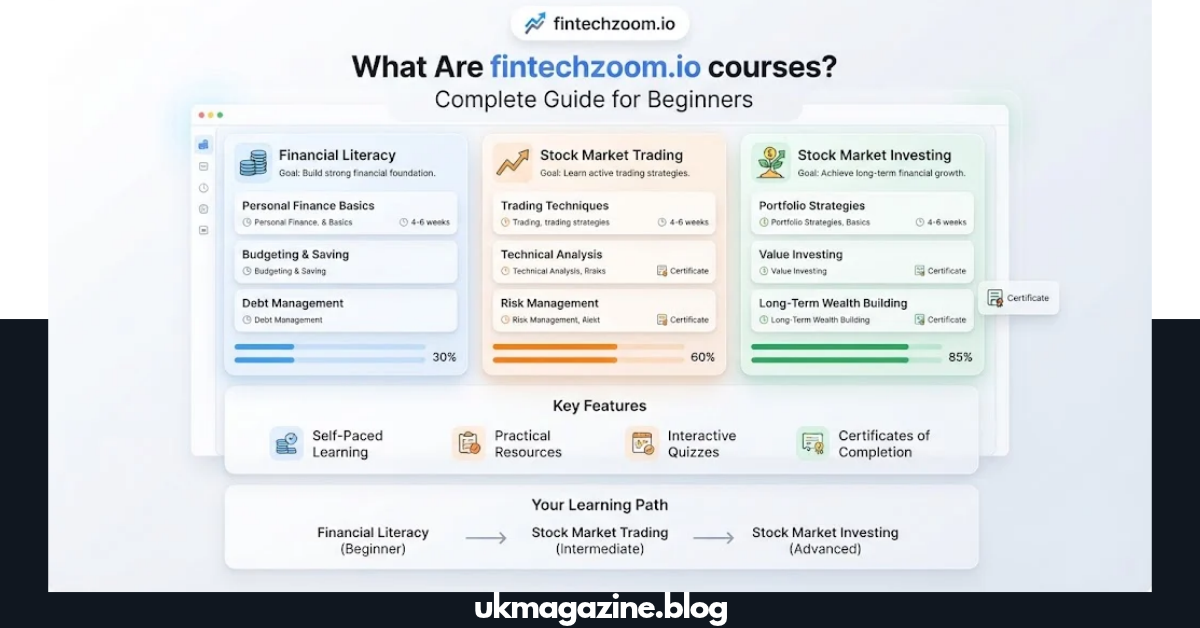
If you are searching for fintechzoom.io courses, you probably want to know what you can learn, who the courses are for, and whether the lessons match your financial goals. FintechZoom IO currently lists programs covering financial literacy, stock market trading, and stock market investing. The published course pages describe self-paced lessons, practical resources, quizzes, and certificates, giving learners several ways to build financial knowledge.
What Are fintechzoom.io courses?
fintechzoom.io courses are online financial education programs published through FintechZoom IO. The current course catalog highlights three main areas: Financial Literacy, Stock Market Trading, and Stock Market Investing.
The courses are designed around different stages of financial learning. A beginner can start with personal finance basics, while a learner with more experience can explore trading techniques or portfolio-focused investing concepts.
FintechZoom describes its learning format as flexible and self-paced. Its main course page also highlights practical examples, interactive exercises, support, and access to course materials.
What Courses Does FintechZoom IO Offer?
The current catalog can be divided into three clear learning paths:
| Course | Main Focus | Listed Duration | Main Audience |
| Financial Literacy | Budgeting, saving, credit, debt, investing basics | 3–5 hours | Beginners, students, professionals |
| Stock Market Trading | Trading methods, charts, trends, risk management | 4–6 hours | New and intermediate traders |
| Stock Market Investing | Portfolio building, assets, diversification, market analysis | 7–8 hours | Beginner and intermediate investors |
The durations come from the individual course pages currently published by FintechZoom IO. Course information can change, so readers should check the live page before enrolling.
Who Should Take fintechzoom.io courses?
The published material is aimed at different experience levels rather than one specific type of learner. The Financial Literacy course mentions students, new investors, and working professionals, while the trading and investing courses describe beginner and intermediate learning paths.
Your starting point should depend on what you already understand.
- New to money management: Start with Financial Literacy.
- Already understand personal finance: Consider Stock Market Investing.
- Interested in active trading: Review the Stock Market Trading curriculum.
- Busy professional: The self-paced structure may fit a flexible schedule.
- Student: Financial Literacy can provide a useful foundation.
Choosing the course that matches your current knowledge can save time and make the lessons easier to follow.
What Does the Financial Literacy Course Teach?
The Financial Literacy course focuses on everyday money management and basic wealth-building concepts. Its listed curriculum covers income, expenses, budgeting, saving, credit scores, debt, emergency funds, financial goals, investing, taxes, retirement planning, and financial tools.
The course also introduces practical ways to organize personal finances. For example, learners can study how to create a budget, reduce unnecessary spending, manage debt, build savings, and begin thinking about long-term financial goals.
Financial Literacy Course Features
According to the published course page, the program includes:
- On-demand video lessons
- Around 3–5 hours of content
- Printable worksheets
- Interactive quizzes
- A completion certificate
- Personal finance exercises
- Investment fundamentals
- Debt-management concepts
- Retirement planning basics
This makes the course more focused on building a financial foundation than learning short-term trading techniques.
What Does the Trading Course Cover?
The Stock Market Trading course focuses on active market participation. Its listed topics include candlestick patterns, price movements, trends, day trading, swing trading, position trading, stop-loss strategies, trading psychology, market indicators, and algorithmic trading.
The curriculum also mentions stock, options, and forex markets. It discusses margin trading and other advanced subjects, so learners should understand the difference between studying a technique and using that technique with real money.
Trading Course Features
The published course page lists:
- 4–6 hours of video lessons
- Practical trading resources
- Interactive quizzes
- A completion certificate
- Chart and strategy materials
- Technical analysis topics
- Trading psychology
- Risk-management concepts
Trading education can explain how markets work, but it cannot remove market risk. A learner should practice concepts carefully before putting capital at risk.
What Does the Investing Course Cover?
The Stock Market Investing course takes a wider portfolio approach. It covers stocks, bonds, mutual funds, ETFs, real estate, alternative investments, asset allocation, diversification, value investing, dividend strategies, and index investing.
The course also introduces options, futures, international markets, artificial intelligence, machine learning, robo-advisors, and wealth-planning topics.
Investing Course Features
FintechZoom lists:
- 7–8 hours of on-demand lessons
- Printable worksheets
- Interactive quizzes
- A completion certificate
- Portfolio-related exercises
- Asset allocation concepts
- Market analysis
- Diversification topics
- Long-term investing concepts
This course is broader than a simple introduction to stocks because it covers several asset classes and portfolio-management ideas.
Are fintechzoom.io courses Beginner-Friendly?
Yes. The published course descriptions state that prior experience is not required, and each program identifies beginner-level learners as part of its audience.
For someone starting from zero, Financial Literacy is the easiest place to understand basic money concepts before moving toward market-specific subjects.
A learner who already understands budgeting, saving, and basic investing can examine the trading or investing curriculum instead. Starting at the correct level helps prevent unnecessary repetition.
Are fintechzoom.io courses Self-Paced?
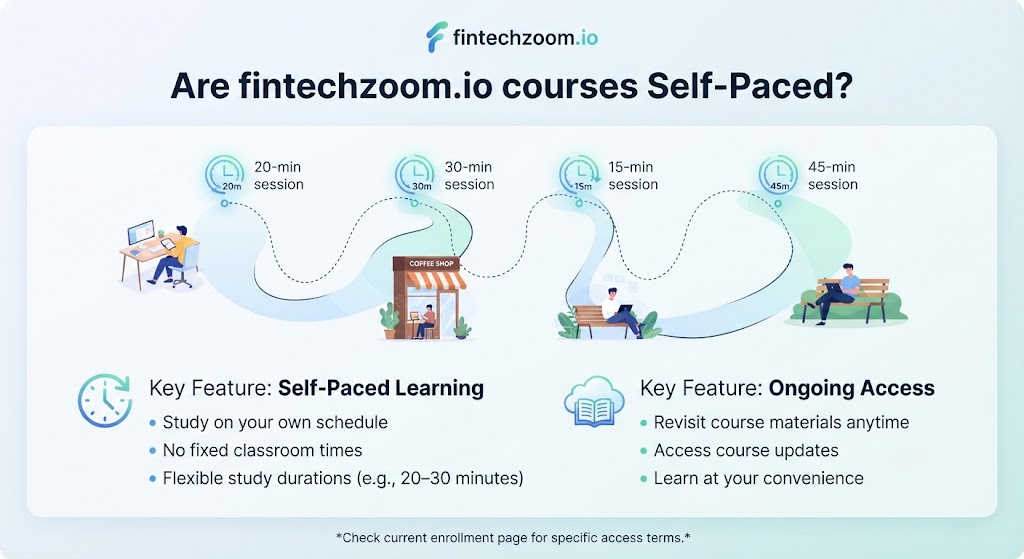
Yes. FintechZoom describes the courses as self-paced and says learners can revisit course materials after completion. The main course page also states that course materials and updates are available for ongoing access.
This structure can suit people who prefer studying for 20–30 minutes at a time instead of following a fixed classroom schedule.
Before purchasing, check the current enrollment page for access conditions, updates, support, refund terms, and any other commercial details.
Do fintechzoom.io courses Include Certificates?
Yes. The individual Financial Literacy, Stock Market Trading, and Stock Market Investing pages state that learners receive a certificate after successfully completing the course.
A course certificate can show that you completed an educational program. However, readers should not automatically treat it as a professional license, regulated qualification, or guarantee of employment.
If you need a credential for a specific job, university, or professional requirement, confirm whether that organization recognizes the certificate.
How Much Do fintechzoom.io courses Cost?
The public course pages reviewed for this article provide detailed curriculum and feature information, but they do not show one consistent price in the visible course content. Pricing may change based on the current enrollment offer.
For that reason, avoid relying on an old price quoted on another website.
Before buying, compare:
- Current course price
- Course duration
- Lifetime or limited access
- Certificate availability
- Refund terms
- Support options
- Included worksheets and resources
- Course updates
- Your actual learning goal
Checking these details gives you a clearer picture of the total value of the course.
What Are the Main Benefits of fintechzoom.io courses?
The value of an online finance course depends on how well its curriculum matches your needs. The current FintechZoom catalog offers several useful learning features.
Main Benefits
- Self-paced video lessons
- Structured financial topics
- Printable worksheets
- Interactive quizzes
- Completion certificates
- Beginner-friendly material
- Trading and investing topics
- Practical examples
- Different learning paths
- Flexible study schedule
The most useful step is to apply what you learn. For example, after a budgeting lesson, create a real monthly budget. After studying portfolio allocation, build a paper portfolio without risking real money.
That approach turns passive video watching into active learning.
Are fintechzoom.io courses Enough to Become a Trader or Investor?
A course can teach concepts, but education alone does not eliminate financial risk. Real markets involve changing prices, fees, taxes, uncertainty, and potential losses.
The U.S. Securities and Exchange Commission states that all investments involve some degree of risk. Its investor education material also explains diversification as one approach for managing exposure to individual investments.
For trading, learners should also understand:
- Position sizing
- Stop-loss planning
- Trading fees
- Market liquidity
- Volatility
- Leverage risk
- Risk-to-reward concepts
- Trading psychology
- Capital preservation
Learning a strategy and proving that the strategy works with your own money are two different things.
fintechzoom.io courses vs Free Financial Education
Paid education is not automatically better than free education. The main advantage of a structured paid course is organization: lessons, quizzes, worksheets, and a defined learning path can make studying easier.
Free educational material can also provide strong foundational knowledge. A smart learner can compare the course syllabus with reliable public resources before spending money.
Ask one simple question:
Does the paid course give me something I cannot easily get from free, trustworthy resources?
That extra value could be structure, exercises, support, organized lessons, or a certificate.
How Should You Choose the Right FintechZoom Course?
Match your goal with the curriculum instead of choosing based only on the course name.
| Your Goal | Course to Examine | Why |
| Learn budgeting | Financial Literacy | Covers everyday money management |
| Improve saving habits | Financial Literacy | Includes saving and expense-management topics |
| Understand credit and debt | Financial Literacy | Covers credit and debt concepts |
| Learn active trading | Stock Market Trading | Covers trading methods and market analysis |
| Understand charts | Stock Market Trading | Includes candlesticks and price movements |
| Build a portfolio | Stock Market Investing | Covers asset allocation and diversification |
| Learn about ETFs | Stock Market Investing | Includes ETFs among its asset classes |
| Explore long-term strategies | Stock Market Investing | Covers index, dividend, and value approaches |
| Learn advanced market topics | Trading or Investing | Both include more advanced financial subjects |
This table compares the published curriculum. It does not promise a particular financial result.
What Should You Check Before Enrolling?
Before purchasing fintechzoom.io courses, review the current course page and answer these questions:
- What is the current price?
- How long does access last?
- What lessons are included?
- Are worksheets included?
- Is the certificate included?
- What support is available?
- What is the refund policy?
- Are future course updates included?
- Does the curriculum match your goal?
- Does the course teach the level you actually need?
FintechZoom’s main course page currently describes support, lifetime access, updates, quizzes, and a 30-day satisfaction guarantee. Because commercial terms can change, verify the current terms directly before payment.
Are fintechzoom.io courses Worth Exploring for Beginners?
The published curriculum gives beginners three distinct starting points. Financial Literacy focuses on personal money skills, Trading focuses on market participation, and Investing focuses more heavily on portfolio construction and asset analysis.
The better question is whether the specific syllabus matches your goal.
Review the lessons, duration, resources, certificate, support, price, and access terms before making a purchase decision.
How to Get Better Results From fintechzoom.io courses
You can make online financial education more useful with a simple study system.
1. Set One Goal
Do not start with five different financial goals. Decide whether you want to improve budgeting, understand investing, or study trading.
2. Take Notes
Write important concepts in simple language. If you cannot explain a topic without looking at the lesson, review it again.
3. Practice Without Real Money
Use sample budgets, spreadsheets, watchlists, and paper portfolios while learning. This gives you practical experience without immediately putting capital at risk.
4. Study Risk Management
Do not focus only on potential returns. Learn how losses happen and how position size, diversification, fees, and volatility affect outcomes.
5. Review Difficult Topics
Return to difficult lessons after a few days. Repetition can make technical concepts easier to understand.
6. Keep a Learning Journal
Record what you learned, what confused you, and what you need to research next.
This process makes fintechzoom.io courses more useful because you actively work with the information instead of simply watching videos.
E-E-A-T and Trust Checks for Financial Education
Financial education requires careful sourcing because financial decisions can affect a person’s financial stability. Google says trust is the most important part of E-E-A-T and places additional emphasis on strong E-E-A-T for topics that can significantly affect financial stability.
For readers, useful trust checks include:
- Clear authorship
- Transparent sources
- Accurate course information
- Updated pricing details
- Clear separation between education and financial advice
- No guaranteed-profit claims
- Proper discussion of investment risk
- Links to authoritative primary sources
Google’s current Search guidance also emphasizes original, useful, people-first content rather than content created mainly to manipulate rankings. Its guidance for AI search experiences follows the same basic principle: provide unique, valuable information that genuinely helps visitors.
Frequently Asked Questions
Answer: fintechzoom.io courses are online financial education programs covering financial literacy, stock market trading, and stock market investing. The published programs include lessons, practical resources, quizzes, and certificates.
Answer: Yes. FintechZoom’s published course descriptions include beginners in their target audience, and the catalog states that prior experience is not required.
Answer: Yes. The individual Financial Literacy, Stock Market Trading, and Stock Market Investing pages state that certificates are provided after successful completion.
Answer: The listed durations vary. Financial Literacy takes about 3–5 hours, Stock Market Trading about 4–6 hours, and Stock Market Investing about 7–8 hours.
Answer: The trading course covers market types, candlestick patterns, trends, day trading, swing trading, position trading, risk controls, indicators, psychology, and other trading subjects. Completing a course does not guarantee profitable trading.
Answer: No. Financial education cannot guarantee investment profits. The SEC states that all investments involve some degree of risk, so learners should understand risk before using real capital.
Conclusion:
fintechzoom.io courses provide three distinct educational paths: financial literacy, stock market trading, and stock market investing. The published programs offer self-paced lessons and practical learning materials, while the individual courses differ in duration, subject depth, and intended audience.
Before enrolling, compare the live syllabus, price, access terms, certificate details, support, and refund policy with your personal learning goal. Use financial courses to build knowledge, practice concepts carefully, and verify important money-related decisions through reliable authoritative sources.