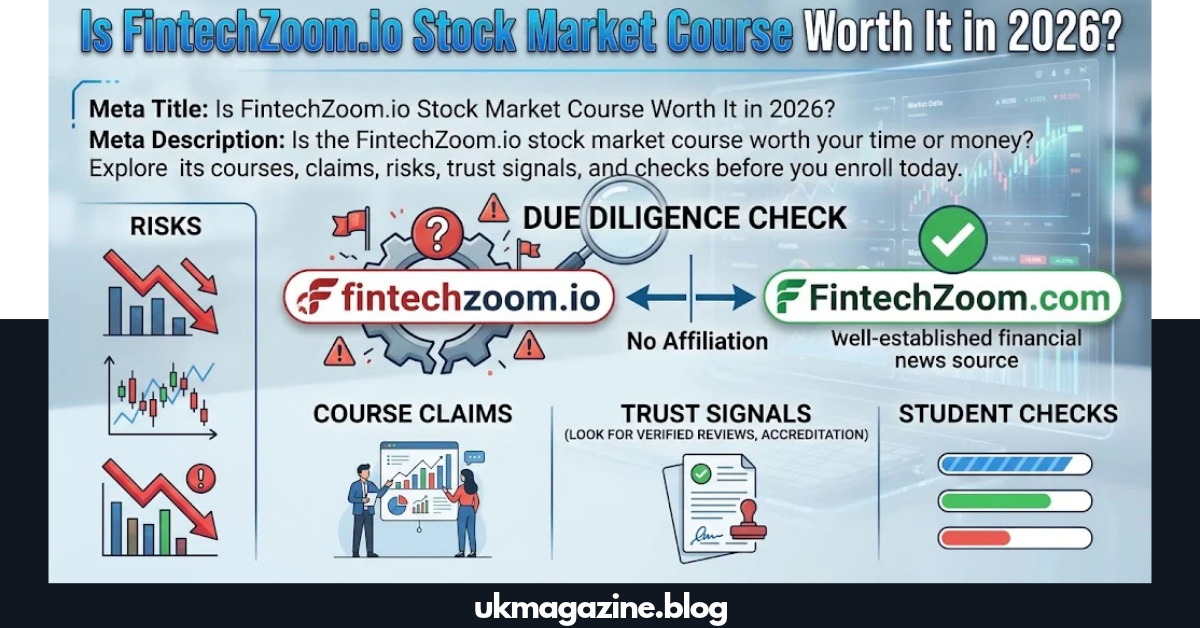
Learning the stock market can feel confusing when charts, trading terms, risk, and investing strategies all appear at once. A structured course may make the learning process easier, but choosing a financial course requires more than reading its sales page. The fintechzoom.io stock market course search deserves extra care because the .io website lists trading and investing programs, while FintechZoom.com separately says the .io domain is not affiliated with it.
What Is the FintechZoom.io Stock Market Course?
The fintechzoom.io stock market course is best understood as a search term for FintechZoom.io’s stock-market education rather than the name of one single program.
The FintechZoom.io courses page currently lists three main areas: Financial Literacy, Stock Market Trading, and Stock Market Investing. The two stock-focused programs have different goals, so readers should not treat trading and long-term investing as the same subject.
The website presents its trading program as the Stock Market Trading Mastery Course and its investing program as the FintechZoom Investment Mastery Course. Both are promoted as educational programs for people with different levels of market experience.
The fintechzoom.io stock market course currently refers to online trading and investing courses published on FintechZoom.io. However, prospective students should verify the operator and affiliation before paying because FintechZoom.com has publicly stated that fintechzoom.io is not affiliated with its official domain.
That distinction is more important than any marketing claim about becoming a successful trader or investor.
What Courses Does FintechZoom.io Offer?
The course section separates financial education into several learning paths.
| Course area | Main purpose | Topics presented by the site | Listed format |
| Financial Literacy | Build basic money skills | Budgeting, saving and financial foundations | Self-paced |
| Stock Market Trading | Learn active trading concepts | Charts, trends, trading styles, risk management and psychology | 4–6 hours of video lessons |
| Stock Market Investing | Learn longer-term investing concepts | Asset classes, diversification, portfolio planning and market analysis | 7–8 hours of video lessons |
These details come from FintechZoom.io’s own published course pages. They should therefore be treated as provider descriptions, not independent proof that completing a course produces profitable investment results.
What Does the Trading Course Teach?
The fintechzoom.io stock market course trading track is aimed at learners who want to understand active market participation.
According to the published course page, topics include candlestick patterns, price trends, day trading, swing trading, position trading, stop-loss strategies, portfolio allocation and trading psychology. It also mentions algorithmic trading, market indicators, options, forex and margin-related topics.
The course page says it is suitable for new traders, intermediate traders and working professionals. It also states that learners receive video lessons, practical resources, quizzes and a certificate of completion.
Important Point About Trading
Learning a trading strategy does not remove market risk.
FINRA’s current guidance explains that frequent intraday trading can lead to losses and that margin trading can expose an investor to losses beyond the money initially deposited. FINRA also advises investors to understand their brokerage firm’s systems, margin rules, trading costs and tax implications before using a frequent-trading strategy.
So, a course can teach a method, but it cannot guarantee the outcome.
What Does the Investing Course Teach?
The investment track takes a broader and more long-term approach.
The published FintechZoom Investment Mastery Course covers topics such as stocks, bonds, mutual funds, ETFs, real estate and alternative investments. It also discusses asset allocation, diversification, value investing, dividend strategies, passive index strategies, portfolio management and market indicators.
The course page also lists subjects including investing psychology, international markets, options, futures, algorithmic trading, artificial intelligence and robo-advisors. The website says the program includes on-demand videos, printable worksheets, interactive quizzes and a certificate.
For beginners, the investing course may be easier to understand as a framework for learning how investments fit into a financial plan, rather than as a promise of quick returns.
Trading and Investing Are Not the Same
One of the biggest mistakes beginners make is treating trading and investing as interchangeable.
Trading usually focuses on shorter-term price movements, market timing, technical analysis and trade execution. Investing generally focuses more on business quality, valuation, diversification, asset allocation and long-term financial goals.
| Factor | Trading | Investing |
| Main focus | Price movement | Long-term ownership |
| Typical time frame | Short to medium term | Medium to long term |
| Common tools | Charts and indicators | Financial statements and valuation |
| Major concern | Execution and risk control | Portfolio construction |
| Emotional challenge | Avoiding impulsive trades | Staying disciplined during volatility |
| Common approach | Day, swing or position trading | Index, value, dividend or growth investing |
The SEC’s Investor.gov explains that stocks can provide growth and dividends but also carry the possibility of losing money. It also highlights diversification and asset allocation as important parts of managing investment risk.
Is FintechZoom.io the Same as FintechZoom.com?
No. Readers should not assume that the two domains represent the same organization.
This is the most important trust issue surrounding the fintechzoom.io stock market course.
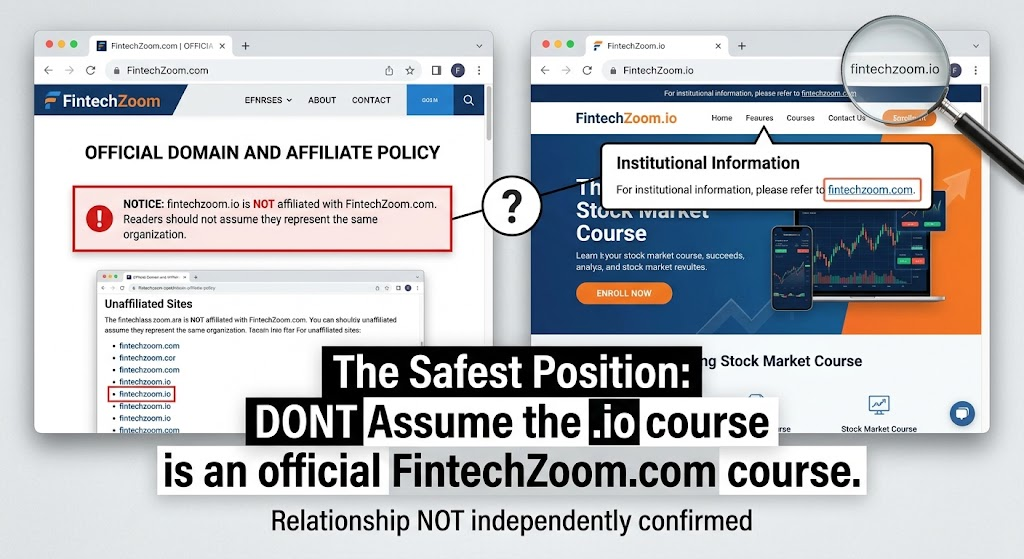
FintechZoom.com has a published page identifying FintechZoom.com as its official domain and explicitly listing fintechzoom.io among websites it says are not affiliated with FintechZoom.
At the same time, FintechZoom.io operates its own website and publishes its own course pages. Its homepage also refers readers to “fintechzoom.com” for institutional information.
Because these statements conflict, the safest position is not to call the .io course an official FintechZoom.com course unless the relationship is independently confirmed.
Why This Matters
A familiar brand name can create a false sense of trust.
Before buying any financial course, check:
- The exact domain name.
- The legal business operating the course.
- Named instructors and their credentials.
- The refund policy.
- The payment recipient.
- The complete syllabus.
- Whether the certificate has any recognized value.
- Whether the seller is making unrealistic income claims.
- Whether the website is affiliated with the brand it appears to represent.
This verification process protects you from confusing a similar name with an official organization.
Is the FintechZoom.io Stock Market Course Legit?
The answer needs more nuance than a simple yes or no.
The website and its course pages are publicly accessible. The Stock Market Trading and Stock Market Investing pages contain descriptions of course topics, formats and claimed benefits.
However, the public warning from FintechZoom.com creates a separate affiliation concern. That warning means readers should not automatically treat the .io course as an official product of FintechZoom.com.
Therefore, the most responsible assessment is:
FintechZoom.io has publicly listed stock-market courses, but its relationship with FintechZoom.com should be independently verified before enrollment or payment.
That is more useful than labeling the course a scam without sufficient evidence.
What Does the Course Claim to Include?
The provider lists several features across its course pages.
| Feature | What the website says |
| Self-paced learning | Learners can study at their own pace |
| Video lessons | Trading course lists 4–6 hours; investing course lists 7–8 hours |
| Practical resources | Charts, strategy guides or worksheets are listed |
| Quizzes | Interactive quizzes are included |
| Certificate | A certificate of completion is advertised |
| Support | The courses page says learners can receive support |
| Lifetime access | The courses page says course materials remain accessible |
| Course updates | The site says learners receive lifetime updates |
| Community | A learner community is advertised |
These are published claims by the course provider. They should not be confused with independently verified student outcomes.
What Is Missing From the Public Course Information?
This is where careful buyers should slow down.
A course page can explain what a program promises without answering every question a customer needs answered before spending money.
Before enrolling, look for clear information about:
- Exact price
- Instructor names
- Instructor qualifications
- Detailed module-by-module syllabus
- Sample lessons
- Assessment standards
- Certificate recognition
- Payment processor
- Refund process
- Legal business identity
- Customer support contact
- Terms and privacy policy
The public course pages clearly describe many subjects and benefits, but a buyer should still confirm the commercial and identity details directly before paying.
Is a Stock Market Course Worth Paying For?
A paid course can be useful when it provides something you cannot easily organize yourself.
For example, a beginner may benefit from a structured sequence that starts with market basics, moves into analysis, then covers risk management and practical exercises.
But price alone does not determine educational value.
A free resource can sometimes teach the basics very well, while an expensive course can still leave important gaps. The better question is whether the course gives you a clear curriculum, reliable information, practical exercises and a safe learning process.
Investor.gov provides free educational material covering stocks, risk, diversification, asset allocation and other investment fundamentals.
Who May Benefit From This Course?
The fintechzoom.io stock market course may appeal to someone who wants a structured introduction rather than scattered information from different websites.
It may be more suitable for:
- Complete beginners.
- New investors who want basic market knowledge.
- Learners interested in technical analysis.
- People comparing trading and investing approaches.
- Working professionals who prefer self-paced lessons.
- Students who want quizzes and structured material.
However, people seeking personalized investment advice should understand the difference between education and financial advice.
A general course cannot know your income, debts, emergency savings, tax position, investment horizon or personal risk tolerance.
Who Should Be Careful Before Enrolling?
Some learners should perform extra checks before purchasing.
1. People Expecting Guaranteed Profits
No legitimate educational course can remove market uncertainty.
Investor.gov states that investments involve risk and that investors can lose some or all of their money.
2. People With Limited Trading Experience
Frequent trading can produce rapid losses. FINRA’s 2026 guidance specifically warns that frequent intraday trading can result in losing some or all of an investment, with margin creating additional risks.
3. People Who Need an Accredited Qualification
A certificate of completion is not automatically the same as a professional financial qualification.
If you need a credential for employment, licensing or academic credit, confirm who recognizes the certificate before paying.
4. People Assuming It Is Official FintechZoom.com Education
This is the biggest point to verify because FintechZoom.com has explicitly stated that fintechzoom.io is not affiliated with it.
What Should Beginners Learn Before Trading?
A strong learning path should start with fundamentals rather than jumping directly into complicated strategies.
Step 1: Understand Stocks
Learn what a stock represents, why companies issue shares and how investors can earn returns through price appreciation or dividends. Investor.gov explains stocks as ownership interests in companies and outlines both their potential benefits and risks.
Step 2: Learn Orders
Understand basic order types such as:
- Market orders
- Limit orders
- Stop orders
- Stop-limit orders
You should know what happens when an order is placed before risking real money.
Step 3: Understand Risk
Learn position sizing, diversification, stop-loss concepts and the difference between risk tolerance and risk capacity.
Step 4: Learn Analysis
Study fundamental analysis, technical analysis and basic financial statements.
Step 5: Practice Without Large Capital
Use paper trading or a simulated environment where appropriate. The purpose is to test whether you can follow rules, not to prove that every trade will be profitable.
Step 6: Build a Written Plan
Write down:
- Your goal.
- Your time horizon.
- Your acceptable risk.
- Your entry rules.
- Your exit rules.
- Your maximum loss.
- Your review process.
This turns financial education into a repeatable process.
What Risk Management Lessons Matter Most?
Risk management should be one of the strongest parts of any trading education.
A beginner should understand that being right about a company does not automatically mean making money on a particular trade.
A stock can move against you even after good research. Market sentiment, economic news, company results, interest rates and unexpected events can all affect prices.
Diversification can reduce the impact of one poor investment, although it cannot eliminate investment risk. Investor.gov recommends considering both asset allocation and diversification when building an investment strategy.
For active traders, risk control becomes even more important because frequent decisions can magnify mistakes.
What About Margin and Day Trading?
This deserves special attention because the trading course page mentions margin and day trading topics.
Margin means borrowing from a brokerage firm to trade securities. It can increase buying power, but it can also increase losses.
FINRA’s 2026 guidance states that margin trading can result in losing more than the amount initially deposited. It also says frequent trading can be time-intensive and may involve additional trading costs and tax considerations.
For beginners, learning about margin is useful. Using margin immediately is a different decision.
Education should come before exposure to high-risk strategies.
How Should You Evaluate the Course Before Paying?
Use this simple checklist before making a purchase.
| Question | What a good answer should provide |
| Who teaches the course? | Real names and verifiable experience |
| What will I learn? | A detailed syllabus |
| How long is it? | Clear lesson and module information |
| What does it cost? | Transparent pricing |
| Can I preview it? | Sample lessons or curriculum |
| What does the certificate mean? | Clear recognition details |
| Can I get a refund? | Written refund conditions |
| Who operates the website? | Clear legal/business identity |
| Is the brand affiliation genuine? | Independent confirmation |
| Does it promise profits? | It should not guarantee investment returns |
| What happens after purchase? | Clear access and support terms |
| Is my payment information safe? | Transparent payment process |
This checklist can help you evaluate the fintechzoom.io stock market course without relying only on promotional language.
FintechZoom.io Course vs Free Investor Education
You do not necessarily need to pay to learn the basics of investing.
Investor.gov offers educational information on stocks, investment products, diversification, asset allocation, risk and other core subjects.
The advantage of a paid course should therefore be structure and practical learning, not simply access to basic definitions.
| Learning option | Main advantage | Main limitation |
| FintechZoom.io courses | Structured course format | Affiliation and commercial details need verification |
| Investor.gov | Free primary investor education | Less focused on one specific course path |
| Brokerage education | Often practical and platform-related | May focus on the broker’s own products |
| Books | Detailed explanations | Less interactive |
| Practice accounts | Hands-on experience | Simulation does not equal real-money risk |
A smart learner can combine several resources rather than relying on one website.
How to Turn a Course Into Real Learning
Watching videos is not enough.
After each lesson, write down three things:
What did I learn?
State the main idea in your own words.
How could I use it?
Connect the lesson to a real market example.
What could go wrong?
Identify the risk or limitation.
For example, after learning about diversification, build a simple sample portfolio and examine how different assets might behave under different market conditions.
After learning technical analysis, review historical charts without placing real trades. The goal is to learn how to form and test a process.
Trust Signals to Check Before Enrollment
Trust matters more when money is involved.
For the fintechzoom.io stock market course, the most important trust signal is not a large claim on a landing page. It is whether the information can be independently checked.
Look for:
- Named and verifiable instructors.
- Clear business ownership.
- Transparent pricing.
- Accessible terms and refund information.
- Accurate course descriptions.
- No guaranteed-profit language.
- Clear distinction between education and investment advice.
- Reliable contact information.
- A clear explanation of the relationship between FintechZoom.io and FintechZoom.com.
The domain issue should receive particular attention because FintechZoom.com has published a warning that specifically names fintechzoom.io as an unaffiliated domain.
Final Verdict: Should You Enroll?
The fintechzoom.io stock market course has publicly listed educational programs covering trading and investing, and the published curriculum includes many subjects that are relevant to beginners. The website also lists videos, quizzes, practical resources and certificates.
But the course should not be purchased simply because its name resembles FintechZoom.com.
The public affiliation warning from FintechZoom.com is a significant reason to verify the operator, payment details, instructors, refund terms and brand relationship first.
My practical verdict: treat the .io program as an unverified third-party financial education offering until its relationship with FintechZoom.com is independently established. If the provider gives you satisfactory answers to the identity, pricing, instructor, curriculum and refund questions, you can then compare its value with free investor education and other established learning options.
Most importantly, do not confuse course completion with investment success. A certificate can show that you completed lessons; it cannot predict what the market will do.
Frequently Asked Questions
The fintechzoom.io stock market course is a general search term for the stock-market education offered on FintechZoom.io. The site currently lists separate Stock Market Trading and Stock Market Investing programs rather than one single stock-market course.
No official affiliation should be assumed. FintechZoom.com has published a warning stating that fintechzoom.io is not affiliated with it. Verify the relationship directly before treating the .io courses as official FintechZoom.com products.
Yes. The Stock Market Trading Mastery Course published on FintechZoom.io covers subjects such as candlestick patterns, trends, day trading, swing trading, position trading, stop-loss strategies, market indicators and trading psychology.
No responsible investor education should guarantee profits. Stock prices can rise or fall, and Investor.gov states that investing involves risk, including the possibility of losing money.
The provider says yes. Its trading course specifically lists new traders among its intended learners, while the investing course says it is designed for beginner and intermediate investors. Beginners should still learn basic risk management before using real money.
No. Verify the details first. Confirm the operator, instructors, curriculum, price, refund terms, payment recipient and relationship with FintechZoom.com before providing payment or sensitive information. This is especially important because FintechZoom.com has publicly warned that fintechzoom.io is unaffiliated with it.
Conclusion
The fintechzoom.io stock market course can be researched as a financial education option, but it should be approached with careful verification rather than automatic trust. Its public pages describe trading and investing courses with structured lessons, quizzes, resources and certificates, yet the separate FintechZoom.com affiliation warning creates an important question that potential students should resolve first.
If you are considering enrollment, start with the checklist in this guide and compare the program with free investor education from primary sources such as Investor.gov. Learn first, verify the provider, understand the risks and only then decide whether the course offers enough value for your money.