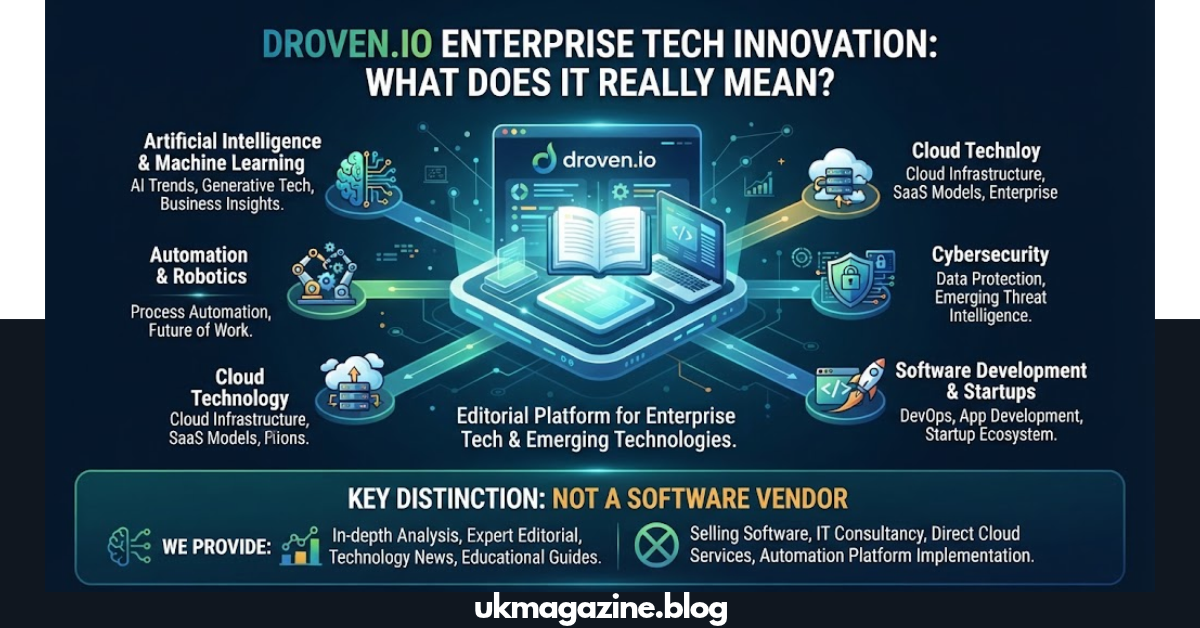
Droven.io enterprise tech innovation refers to the technology-focused content and broader enterprise innovation topics associated with Droven.io, including artificial intelligence, machine learning, automation, software development, robotics, cloud technology, and emerging technology. The official Droven.io website describes itself as an editorial platform covering AI, emerging technologies, startups, development, robotics, and future technology rather than presenting a conventional enterprise software product.
That distinction matters. A technology information platform can help readers understand new technologies, but it should not automatically be treated as a software vendor, automation platform, cloud provider, or enterprise IT consultancy.
What Is Droven.io Enterprise Tech Innovation?
Droven.io enterprise tech innovation combines two ideas: Droven.io’s technology coverage and the broader process of using modern technology to improve business operations.
The official site currently describes Droven.io as a technology and AI blog focused on areas such as AI news, AI tools, machine learning, generative AI, robotics, startups, development, and future technology.
Enterprise technology innovation goes beyond simply buying new software. It involves identifying a business problem, selecting an appropriate technology, integrating it into existing processes, managing risk, and measuring whether the change creates a useful result.
What Does Droven.io Enterprise Tech Innovation Mean?
In simple terms, droven.io enterprise tech innovation can be understood as a research topic connecting Droven.io’s technology coverage with the way organizations adopt emerging digital technologies.
This includes areas such as:
- Artificial intelligence
- Generative AI
- Machine learning
- Business automation
- Cloud computing
- Cybersecurity
- Data analytics
- Software development
- Robotics
- Digital transformation
- Technology startups
- Future-of-work technology
The important point is that these technologies serve different business needs. A company may use cloud infrastructure for scalability, AI for information processing, automation for repetitive workflows, and analytics for better decision-making.
Is Droven.io an Enterprise Software Product?
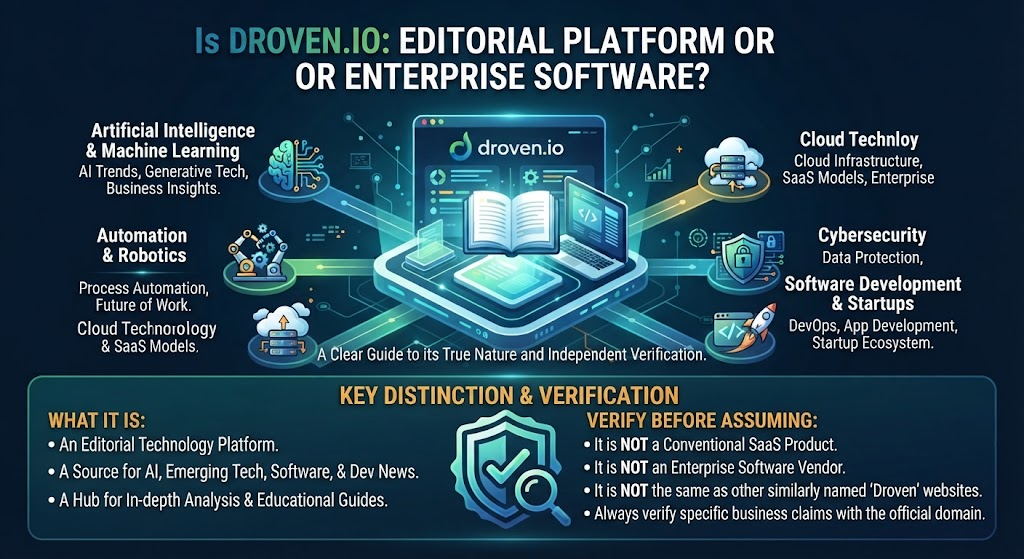
Based on the current public description on Droven.io, readers should treat it primarily as an editorial technology platform, not as a conventional enterprise software application. Its homepage presents technology articles and topic categories rather than a typical SaaS dashboard, enterprise pricing structure, or software deployment model.
This distinction prevents a common misunderstanding.
| Question | What the available public information indicates |
| Is Droven.io a technology website? | Yes |
| Does it publish AI-related information? | Yes |
| Does it cover emerging technology? | Yes |
| Does it cover software and development? | Yes |
| Does its homepage present a conventional SaaS product? | No |
| Is it the same as every similarly named Droven website? | No |
| Should business claims be independently verified? | Yes |
The last point is especially important because multiple websites using similar Droven-related names appear across search results. Always verify that a claim actually refers to droven.io rather than another domain.
What Technologies Does Droven.io Cover?
1. Artificial Intelligence
Artificial intelligence is one of the central subjects associated with Droven.io. AI can support enterprise use cases such as document analysis, customer-service assistance, forecasting, knowledge retrieval, content workflows, and decision support.
However, companies should evaluate an AI system according to its specific use case. Accuracy, privacy, security, integration, cost, human oversight, and measurable business outcomes all matter.
2. Generative AI
Generative AI can produce or transform text, images, software code, audio, and other forms of digital content.
For businesses, the practical question is not simply whether generative AI is powerful. The better question is whether it can solve a clearly defined problem without creating unacceptable security, privacy, compliance, or quality risks.
NIST’s AI Risk Management Framework provides organizations with a voluntary structure for considering trustworthy AI throughout design, development, deployment, use, testing, and evaluation.
3. Machine Learning
Machine learning enables software systems to identify patterns from data and use those patterns to support predictions or classifications.
Enterprise applications can include:
- Demand forecasting
- Fraud detection
- Recommendation systems
- Predictive maintenance
- Customer segmentation
- Risk analysis
- Quality control
The quality of the underlying data often matters as much as the algorithm. Poor or incomplete data can produce unreliable outputs even when the technology itself works as designed.
4. Business Automation
Automation focuses on reducing repetitive manual work through software and digital workflows.
Examples include:
- Automated invoice processing
- Customer-support routing
- Data entry
- Report generation
- Employee onboarding workflows
- Document classification
- Approval processes
A successful automation project starts with a process map. Teams should understand the existing workflow before deciding which steps deserve automation.
5. Cloud Computing
Cloud computing gives organizations access to computing, storage, databases, networking, security, and other services without requiring every workload to run on privately managed infrastructure.
AWS’s Cloud Adoption Framework, for example, organizes cloud transformation around business, people, governance, platform, security, and operations perspectives.
This illustrates why enterprise cloud adoption involves more than moving servers. Organizations also need governance, skills, security controls, operating processes, and clear business objectives.
6. Cybersecurity
Digital innovation increases the importance of cybersecurity.
Organizations adopting AI, cloud platforms, APIs, connected applications, and automated workflows should consider:
- Identity and access management
- Data protection
- Encryption
- Network security
- Application security
- Monitoring
- Incident response
- Vendor risk
- Regulatory requirements
Security should become part of the technology lifecycle rather than an afterthought.
7. Robotics
Robotics connects software intelligence with physical machines.
Enterprise applications can include manufacturing, logistics, warehouse operations, inspection, healthcare support, and other environments where physical automation can improve consistency or productivity.
The business case depends on factors such as equipment cost, maintenance, workforce requirements, safety, integration, and expected utilization.
Why Does Enterprise Tech Innovation Matter?
Droven.io enterprise tech innovation matters because businesses increasingly need to connect technology decisions with measurable operational goals.
Buying technology without a defined problem can create unnecessary complexity. A stronger approach starts with the business challenge and then determines whether technology provides a practical solution.
For example:
Business problem → Technology option → Implementation → Measurement → Improvement
This approach keeps innovation connected to outcomes.
Common Business Goals
Organizations often pursue technology projects to:
- Reduce repetitive work
- Improve customer experiences
- Increase operational visibility
- Strengthen cybersecurity
- Modernize legacy systems
- Improve data access
- Accelerate product development
- Support employees
- Create new digital services
- Improve decision-making
AWS similarly recommends connecting transformation opportunities with strategic objectives and measurable business outcomes when planning cloud transformation.
How Does Droven.io Enterprise Tech Innovation Work in Practice?
A practical enterprise innovation process can follow seven stages.
Step 1: Identify the Problem
Start with a specific business issue.
Instead of saying, “We need AI,” define the problem more precisely:
“Our support team spends too much time answering repetitive customer questions.”
That statement creates a measurable starting point.
Step 2: Investigate Technology Options
Research whether AI, automation, analytics, cloud services, robotics, or another technology actually fits the problem.
This is where technology publications can help readers understand terminology and emerging possibilities.
Step 3: Check Feasibility
Evaluate:
- Existing infrastructure
- Data availability
- Integration requirements
- Security
- Privacy
- Budget
- Internal skills
- Vendor support
- Regulatory obligations
Step 4: Run a Controlled Pilot
A small pilot can reveal problems before an organization commits to a large deployment.
Choose a narrow workflow with measurable targets.
Step 5: Measure Results
Useful measurements might include:
| Metric | Example measurement |
| Processing time | Minutes per transaction |
| Cost | Cost per completed task |
| Accuracy | Percentage of correct outputs |
| Productivity | Tasks completed per employee |
| Customer experience | Response or resolution time |
| Reliability | System availability |
| Adoption | Percentage of intended users |
| Security | Number and severity of incidents |
Step 6: Review Risk
For AI projects, organizations can use established frameworks such as NIST AI RMF to structure risk-management activities around Govern, Map, Measure, and Manage.
Step 7: Scale Carefully
Only expand the technology after the pilot demonstrates acceptable performance, security, cost, and user adoption.
Scaling a weak process simply makes the problem larger.
Droven.io Enterprise Tech Innovation vs Traditional IT
Traditional IT often focuses on keeping existing systems available, secure, and functional.
Enterprise innovation adds another question:
How can technology improve the way the organization operates?
| Traditional IT Focus | Innovation Focus |
| System maintenance | Process improvement |
| Infrastructure | Digital transformation |
| Technical support | Business enablement |
| System uptime | Business outcomes |
| Existing applications | New technology opportunities |
| Incident resolution | Continuous improvement |
| IT operations | Cross-functional transformation |
Both functions matter. An innovative application cannot deliver value if the underlying infrastructure, security, governance, and support processes are unreliable.
Who Can Benefit From Droven.io?
Droven.io enterprise tech innovation can be useful as a research topic for several audiences.
Business Owners
Business owners can use technology coverage to understand new tools before discussing them with vendors or technical teams.
IT Managers
IT professionals can use technology research to identify emerging categories worth investigating.
Developers
Developers may benefit from information about AI, software development, machine learning, robotics, and related technologies.
Startup Founders
Startup teams can follow emerging technologies and identify potential product opportunities.
Students
Students can use accessible technology explanations to build foundational knowledge before moving into technical documentation.
Technology Enthusiasts
Readers who want to understand where AI and digital technology are heading can use the platform as a starting point for exploration.
How Should Businesses Evaluate Technology Information?
Not every article should become the basis for a major technology purchase.
A reliable research process should include several checks.
Check the Original Source
If an article discusses a specific product, model, security capability, API, certification, or pricing plan, visit the organization’s official documentation.
Separate Claims From Evidence
A statement such as “this technology can automate customer service” is different from evidence showing that it successfully performs a particular workload.
Verify Technical Specifications
Check official documentation for:
- Supported integrations
- Security features
- Data handling
- API availability
- Service limitations
- Pricing
- Deployment options
- Compliance information
Test Before Scaling
A pilot gives the organization its own evidence rather than relying entirely on marketing claims.
This principle is particularly important when researching droven.io enterprise tech innovation because the term can refer to a broad technology topic rather than a single deployable enterprise product.
What Makes Enterprise Innovation Successful?
Technology alone does not guarantee successful transformation.
A strong program usually combines several elements:
- Clear business objectives
- Leadership support
- Reliable data
- Appropriate technology
- Security controls
- Employee training
- Effective governance
- Integration with existing systems
- Measurable outcomes
- Continuous improvement
AWS’s enterprise transformation guidance similarly emphasizes business strategy, financial management, operations, and people and culture as connected transformation capabilities.
Common Mistakes to Avoid
Businesses can reduce technology risk by avoiding several common mistakes.
Choosing Technology Before Defining the Problem
Starting with a popular technology can result in a solution looking for a problem.
Ignoring Existing Systems
A new application may fail if it cannot exchange data with the systems employees already use.
Treating AI as Fully Autonomous
Important AI applications may require human review, especially when errors could affect customers, finances, safety, or compliance.
Neglecting Cybersecurity
New integrations create new access points. Security architecture should be part of the implementation plan.
Measuring Activity Instead of Results
Counting how many employees use a tool does not prove that the project created business value.
Scaling Too Quickly
A successful pilot does not automatically prove that a technology will work across every department or region.
A Practical Enterprise Innovation Checklist
Before adopting a new technology, ask:
- What business problem are we solving?
- How is the problem measured today?
- What technology could address it?
- What data does the solution require?
- How will it integrate with existing systems?
- What security risks could it introduce?
- What privacy requirements apply?
- Who owns the project?
- Who will use the system?
- What training will employees need?
- What will the pilot cost?
- What result would justify expansion?
- How will we monitor performance after launch?
This checklist turns droven.io enterprise tech innovation from a broad search phrase into a practical framework for technology research.
Droven.io Enterprise Tech Innovation: Key Takeaways
| Area | Practical takeaway |
| Droven.io | Technology and AI-focused editorial platform |
| Enterprise innovation | Applying technology to meaningful business problems |
| AI | Useful for selected analytical and automation workloads |
| Generative AI | Powerful but requires governance and risk assessment |
| Automation | Best suited to clear, repeatable workflows |
| Cloud | Supports scalable digital infrastructure and transformation |
| Cybersecurity | Essential across modern technology deployments |
| Robotics | Connects digital intelligence with physical processes |
| Data | Provides the foundation for analytics and many AI systems |
| Governance | Helps control security, privacy, risk, and accountability |
| Measurement | Determines whether innovation creates real value |
| Research | Primary documentation should validate important claims |
Is Droven.io Reliable for Enterprise Technology Research?
Droven.io can be used as a starting point for technology research, but important enterprise decisions should be validated through primary sources and official technical documentation.
The site’s own description establishes its role as an editorial technology platform. For technical decisions, readers should then consult sources such as NIST for AI risk guidance, AWS or another cloud provider for cloud architecture documentation, and the official documentation of the specific product being evaluated.
This layered research method provides stronger evidence than relying on a single article.
What Is the Future of Enterprise Tech Innovation?
Droven.io enterprise tech innovation sits within a technology environment that continues to expand across AI, cloud computing, automation, cybersecurity, robotics, software engineering, and data systems.
The next stage of enterprise innovation will not simply be about adopting more tools. Organizations will need to connect technology with business strategy, responsible governance, employee capability, security, and measurable outcomes.
NIST’s current AI guidance reflects this broader approach by emphasizing risk management throughout the AI lifecycle, while AWS’s cloud framework similarly connects technology transformation with business, people, governance, security, platform, and operations capabilities.
For readers, that means the most useful technology research is not the content that promises instant transformation. It is the information that clearly explains what a technology does, where it fits, what evidence supports it, and what limitations should be considered.
Frequently Asked Question
Answer: Droven.io enterprise tech innovation refers to the relationship between Droven.io’s technology coverage and the broader use of modern technologies to improve enterprise operations. The topics include AI, machine learning, automation, software, robotics, and emerging technology.
Answer: The current Droven.io website presents itself as an editorial technology platform rather than a conventional enterprise SaaS product. Its public homepage focuses on technology and AI content categories.
Answer: Droven.io currently highlights AI news, AI tools, machine learning, generative AI, robotics, startups, development, and future technology.
Answer: Yes. Businesses can use it to learn about technology topics and emerging concepts, but important technical, security, compliance, and purchasing decisions should be confirmed through primary documentation.
Answer: Companies should start with a measurable business problem, assess technology options, test a controlled pilot, evaluate security and risk, measure outcomes, and scale only after the solution demonstrates value.
Answer: AI governance helps organizations manage issues involving reliability, security, privacy, transparency, accountability, and other risks. NIST’s AI Risk Management Framework provides voluntary guidance organized around governing, mapping, measuring, and managing AI risks.
Conclusion
Droven.io enterprise tech innovation is best understood as a technology research topic rather than automatically treating the phrase as the name of a standalone enterprise software product. Droven.io’s current public website focuses on AI, emerging technologies, development, robotics, startups, and future technology.
For businesses, the bigger lesson is practical: technology creates value when it solves a real problem, fits the organization’s systems, protects important data, earns user adoption, and produces measurable results.