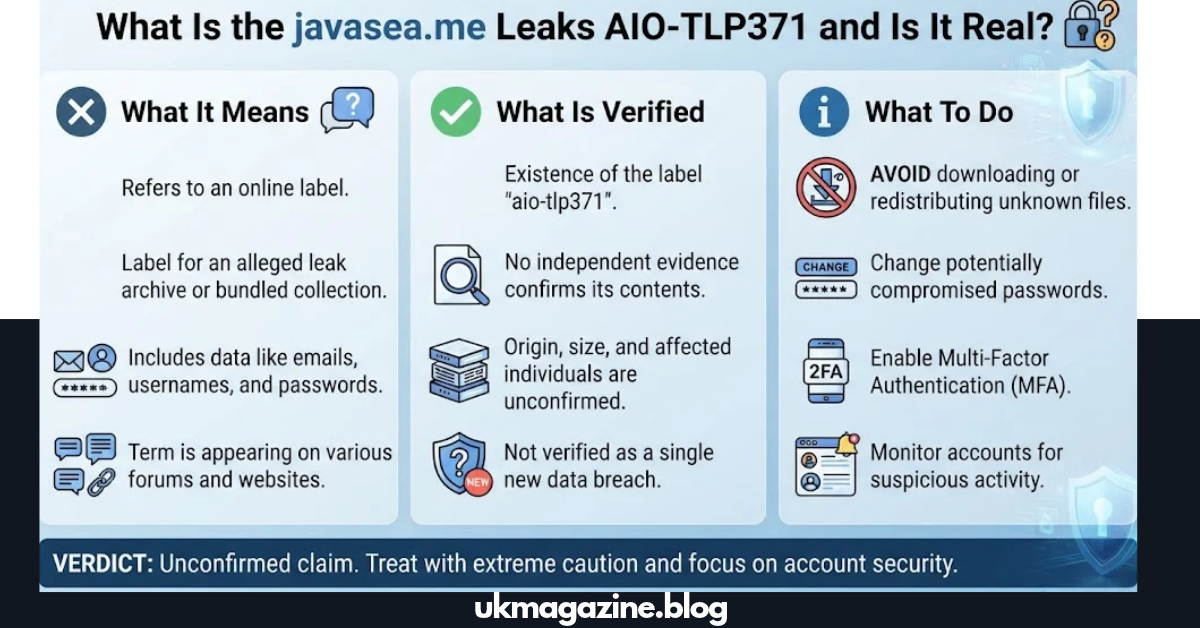
The thejavasea.me leaks aio-tlp371 phrase refers to an online label associated with an alleged leak archive or bundled collection. Current public reporting does not provide enough independent evidence to confirm its exact contents, origin, size, affected people, or whether it represents a new data breach. Several recent pages discuss the term, but repeating a claim across websites does not independently verify it.
Readers should also avoid downloading or redistributing unknown leak files. If you are concerned about your own accounts, changing reused passwords and enabling multi-factor authentication are safer and more useful steps.
What Is the thejavasea.me Leaks AIO-TLP371 Topic?
The phrase thejavasea.me leaks aio-tlp371 combines a website name with an apparent archive or package identifier.
Online articles commonly interpret “AIO” as “all-in-one,” while “TLP371” appears to function as a label or identifier. However, there is no authoritative documentation establishing exactly who created the name or what each part officially means.
That distinction matters because a technical-looking name can make an unverified claim appear more official than it is.
Simple Breakdown
| Term | What it appears to mean | What it does not prove |
| TheJavaSea.me | Website/domain referenced in online discussions | That the site created or verified every alleged file |
| AIO | Commonly understood online as “all-in-one” | That the package contains every claimed dataset |
| TLP371 | Apparent package, archive, or release identifier | That it is an official cybersecurity classification |
| Leak | A claim that information was exposed or distributed | That the material is authentic or newly obtained |
| AIO-TLP371 | Combined label used online | A confirmed breach with a known victim or record count |
Is AIO-TLP371 an Official TLP Classification?
No. AIO-TLP371 is not an official Traffic Light Protocol label.
The Forum of Incident Response and Security Teams (FIRST) maintains the official Traffic Light Protocol standard. Its TLP 2.0 documentation lists four valid labels: TLP, TLP, TLP, and TLP. FIRST also states that only labels included in its standard are considered valid TLP labels.
Therefore, the “TLP” in AIO-TLP371 should not automatically be interpreted as an official FIRST security classification.
The number “371” also should not be treated as a TLP severity level, victim count, or official breach number.
Is the thejavasea.me Leaks AIO-TLP371 Claim Confirmed?
Based on the public information reviewed for this article, the specific claims surrounding AIO-TLP371 remain insufficiently verified.
Several websites have published articles about the phrase, which confirms that the keyword is circulating online. However, those articles do not establish the exact origin, authenticity, contents, scope, or affected population of the alleged material.
This creates an important difference between online discussion and independent verification.
A responsible article should not turn an unverified archive label into a confirmed cybersecurity incident simply because many pages repeat the same description.
What Is Actually Verified?
The following table separates observable information from claims that still need evidence.
| Question | Current assessment |
| Is the phrase AIO-TLP371 being discussed online? | Yes |
| Do multiple websites mention the phrase? | Yes |
| Is “AIO” commonly used to mean “all-in-one”? | Yes, as informal terminology |
| Is AIO-TLP371 an official FIRST TLP label? | No |
| Does FIRST recognize TLP371? | No |
| Is a specific victim organization confirmed? | Not established |
| Is a verified record count available? | Not established |
| Is a verified file size available? | Not established |
| Is the exact origin of the alleged archive confirmed? | Not established |
| Is every claimed file authentic? | Not established |
| Should readers download the alleged material to investigate it? | No |
This distinction is especially important for search readers. A page can report that a keyword exists without claiming that every description attached to it is true.
Why Are Online Claims About AIO-TLP371 Confusing?
The phrase thejavasea.me leaks aio-tlp371 has attracted different descriptions across websites.
Some pages describe it as an archive, while others describe it as a compiled data package. Other pages attach specific claims to its contents without presenting independent evidence for those details.
When sources disagree about basic facts, readers should slow down before accepting precise claims.
A useful verification checklist includes:
- Who originally reported the alleged exposure?
- Is there an affected organization confirming it?
- Is there a cybersecurity advisory?
- Is there a regulator statement?
- Are technical indicators available from a trusted security source?
- Are claimed record counts independently supported?
- Is the information new or recycled from an older incident?
Without answers to these questions, exact claims should remain labeled as unconfirmed.
Does the TLP Name Prove a Cybersecurity Breach?
No.
The official Traffic Light Protocol exists to communicate how potentially sensitive information should be shared. It is not a system for proving that information was stolen or that a particular leak occurred. FIRST describes TLP as a set of four labels for indicating sharing boundaries.
That means a term containing “TLP” does not automatically connect an online archive to FIRST.
For thejavasea.me leaks aio-tlp371, readers should therefore treat the identifier as an apparent online label rather than an official cybersecurity classification.
What Risks Can Come From Unknown Leak Archives?
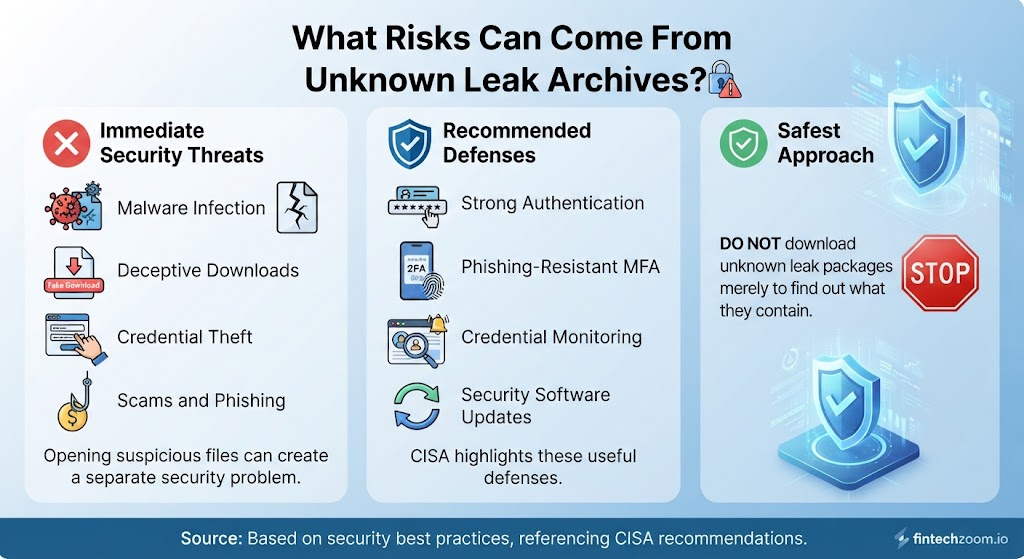
Even when a particular leak claim is not verified, unknown files can create genuine security risks.
A person who downloads an unfamiliar archive could encounter malicious software, deceptive downloads, credential-stealing pages, or scams. Opening suspicious files can create a separate security problem from the alleged leak itself.
CISA recommends strong authentication protections and specifically highlights phishing-resistant MFA and credential monitoring as useful defenses against compromised credentials.
The safest approach is simple: do not download unknown leak packages merely to find out what they contain.
Could Leaked Passwords Put Other Accounts at Risk?
Yes, if a password was reused.
The FTC explains that criminals can use credentials obtained through breaches to attempt access to other services, particularly when people reuse passwords. It recommends changing compromised passwords and changing similar or reused passwords on other accounts.
This is why the practical response to thejavasea.me leaks aio-tlp371 should focus on account security rather than trying to obtain the alleged archive.
A Safer Password Setup
Use:
- A different password for every important account
- Long, unique passwords or passphrases
- A reputable password manager
- Multi-factor authentication
- An authenticator app or security key when available
- Recovery information that you control
Avoid using the same password for email, banking, social media, shopping, and crypto accounts.
What Should You Do If You Think Your Information Was Exposed?
You do not need to download leaked material to protect yourself.
1. Change Reused Passwords
Start with your email account because it can often be used to reset other accounts.
Then change passwords on financial, social media, shopping, cloud, and other important services where you reused the same password.
2. Enable MFA
Multi-factor authentication adds another verification step beyond a password. The FTC notes that MFA can help protect accounts even when a password has been compromised.
Where available, consider an authenticator app or security key instead of relying only on text messages.
3. Review Recent Login Activity
Check your important accounts for:
- Unknown devices
- Unfamiliar locations
- Unexpected password changes
- New recovery email addresses
- New phone numbers
- Unknown connected applications
If you see something you did not authorize, use the service’s official account-recovery process.
4. Watch for Phishing
A suspected data exposure can lead to fake security emails and messages.
Do not click an unexpected password-reset link. Instead, open the company’s official website or app yourself and check your account there.
5. Monitor Financial Accounts
If financial information may have been exposed, review recent transactions and account activity.
The FTC recommends checking for unfamiliar accounts or transactions and using appropriate identity-theft recovery resources after a confirmed exposure.
Should You Visit or Download From a Leak Site?
No.
There is no security benefit in downloading an unverified archive simply to investigate a keyword. The material could be incomplete, mislabeled, malicious, illegally distributed, or unrelated to the claims attached to it.
The safer method is to rely on legitimate breach notifications, the affected company’s security announcements, established cybersecurity organizations, and account-security tools.
This approach also avoids redistributing potentially private information belonging to other people.
How Can You Check Whether Your Accounts Are at Risk?
If you are worried about an account, start with the account provider.
Look for official breach notifications, security alerts, password-reset messages, and suspicious login activity. If an organization confirms that your information was exposed, follow its recommended remediation steps.
You can also use reputable breach-notification and credential-monitoring services rather than searching for leaked databases yourself.
For organizations, CISA recommends credential monitoring and stronger authentication controls as part of protecting against compromised credentials.
thejavasea.me Leaks AIO-TLP371 vs. a Confirmed Data Breach
These terms should not be treated as identical.
| Feature | Unverified AIO-TLP371 claim | Confirmed data breach |
| Public discussion | May exist | Usually exists |
| Independent evidence | May be limited | Available from credible sources |
| Confirmed victim | Not necessarily | Normally identified |
| Confirmed source | Not necessarily | Investigated or documented |
| Record count | May be claimed | Supported by evidence or affected entity |
| Official notification | Not necessarily | Often provided when legally required |
| Security guidance | General precautions | Incident-specific remediation |
| Authenticity | May be uncertain | Investigated and documented |
The distinction protects readers from treating search-engine repetition as proof.
What Should Website Owners and Businesses Do?
Businesses should take a different approach because they may manage employee credentials, customer information, payment details, or other sensitive records.
If an organization suspects an exposure, it should:
- Investigate the suspected source.
- Identify potentially affected systems.
- Reset compromised credentials.
- Review authentication logs.
- Revoke suspicious sessions and tokens.
- Enable or strengthen MFA.
- Preserve relevant evidence.
- Follow applicable breach-notification requirements.
- Notify affected users when appropriate.
- Continue monitoring after remediation.
CISA guidance emphasizes MFA, credential monitoring, access controls, and strong security practices when dealing with compromised credentials.
How to Judge Future Articles About AIO-TLP371
Search results about thejavasea.me leaks aio-tlp371 can change quickly, so readers should evaluate new claims instead of assuming that newer publication dates mean better evidence.
Use this five-point test:
- Source: Does the article cite an affected organization or recognized security authority?
- Evidence: Does it provide verifiable technical evidence?
- Independence: Is the information independently confirmed?
- Specificity: Are numbers and dates actually supported?
- Transparency: Does the writer clearly separate facts from allegations?
A page that simply repeats another blog’s claims adds visibility, not verification.
Why Repetition Does Not Equal Proof
A common problem with trending cybersecurity keywords is the creation of a citation loop.
One website publishes an allegation. Another website summarizes it. A third site repeats the summary. Soon, dozens of pages may discuss the same statement.
Search engines can then show many results for the same claim even though those pages ultimately rely on one unsupported source.
That is why trustworthy reporting should prioritize primary evidence over the number of websites repeating a claim.
Key Facts at a Glance
| Topic | Takeaway |
| Main keyword | thejavasea.me leaks aio-tlp371 |
| AIO meaning | Commonly interpreted as “all-in-one” |
| TLP371 | Appears to be an informal/package identifier |
| Official TLP status | Not an official FIRST label |
| Confirmed breach | Not independently established from the public evidence reviewed |
| Confirmed victim | Not established |
| Verified record count | Not established |
| Safe response | Secure accounts and avoid unknown leak files |
| Password action | Change reused or exposed passwords |
| Authentication | Enable MFA |
| Best evidence | Affected organizations and trusted security authorities |
Frequently Asked Questions
Answer: It is an online phrase associated with an alleged leak archive or bundled collection. The exact origin, contents, authenticity, and scope of the alleged material have not been independently established by reliable public evidence reviewed for this article.
Answer: No. FIRST’s official TLP 2.0 standard recognizes TLP, TLP, TLP, and TLP. AIO-TLP371 is not an official FIRST classification.
Answer: No. A label or online discussion does not establish that a specific breach occurred. A confirmed incident requires independent evidence connecting the exposed material to a source, organization, or security event.
Answer: No. Downloading an unknown archive can expose your device and accounts to malware, scams, or other risks. Use legitimate breach notifications and account-security tools instead.
Answer: Change the password immediately and change it anywhere else you reused it. Then enable MFA and review recent account activity. The FTC recommends these steps after credential exposure.
Answer: There is no evidence in the official FIRST TLP documentation that connects AIO-TLP371 with the organization’s Traffic Light Protocol. FIRST’s documented TLP system uses four labels and does not include TLP371.
Conclusion:
The most important point about thejavasea.me leaks aio-tlp371 is the difference between an online claim and a verified security incident. The keyword is being discussed across the web, but public material reviewed for this article does not establish the exact contents, origin, affected organization, or scale of the alleged archive.
Readers do not need to access leaked files to protect themselves. Use unique passwords, enable MFA, monitor important accounts, watch for phishing attempts, and rely on primary cybersecurity sources when new information appears.