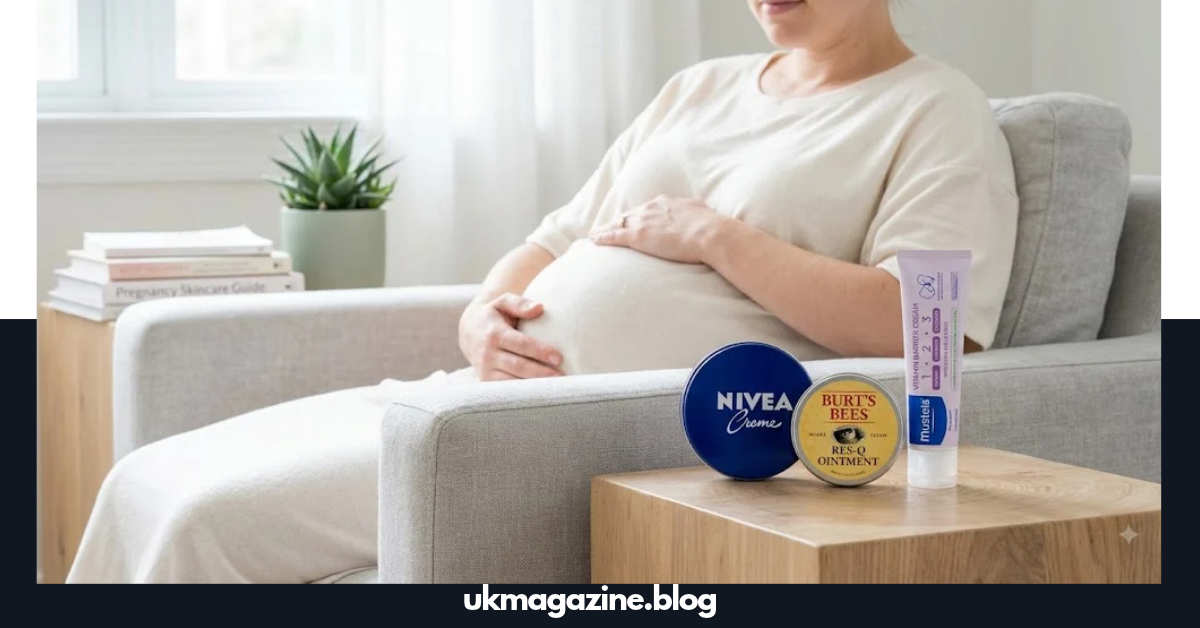
Pregnancy changes everything including how you look at your skincare products. That moisturizer you have used for years suddenly feels like a potential risk. If you are asking yourself, “I’m a pregnant woman. Are Nivea products safe compared to Burt’s Bees or Mustela?” you are not alone. This is one of the most common questions expecting mothers ask.
The short answer is that most basic products from all three brands are considered low-risk during pregnancy. But that does not mean every product from these brands is automatically safe. The real answer depends on what is inside the bottle, not the name on the label.
This guide breaks down the ingredients that actually matter. It compares Nivea, Burt’s Bees, and Mustela side by side. You will learn which products to reach for and which ones to avoid. Let’s dive in and find the safest skincare for you and your baby.
Why Pregnancy Makes You Question Your Skincare
Hormones go wild during pregnancy. Estrogen and progesterone rise sharply, changing your skin in unexpected ways. Some women get that famous “pregnancy glow.” Others get melasma, hormonal acne, or sudden reactions to products they have used for years.
There is also a real biological reason for caution. Skin is not a sealed barrier. Some topical ingredients can absorb into your bloodstream in small amounts. During pregnancy, that bloodstream reaches your baby too. This does not mean every lotion is risky. It just means a specific list of ingredients deserves attention.
The first trimester is when a baby’s major organs form. This is why retinoids and hydroquinone draw the strictest caution during those early weeks. By the third trimester, concerns shift toward stretch marks, itching, and skin stretching over a growing belly. The ingredients worth avoiding stay fairly consistent across all trimesters.
The Ingredients That Actually Matter — Not the Brand
Dermatologists do not judge pregnancy skincare by the logo. They judge it by the formula. Here are the key ingredients to watch for, no matter which brand you choose.
Retinoids
Retinol, retinyl palmitate, tretinoin, and adapalene all belong to this family. Oral isotretinoin carries a well-documented link to birth defects. This is why dermatologists recommend skipping topical retinoids too, even though absorption through skin is much lower. If a product markets itself as “anti-aging” or “cell renewal,” check the ingredient list before buying it.
Hydroquinone
This skin-lightening ingredient appears in dark-spot correctors. Pregnancy itself is one of the most common causes of dark spots, so this can be confusing. The problem is absorption. Hydroquinone is absorbed more readily through skin, so it is commonly avoided during pregnancy.
Chemical Sunscreens
Ingredients like oxybenzone and avobenzone are considered medium-risk during pregnancy. Mineral sunscreens with zinc oxide are generally the safer choice.
Parabens and Phthalates
These preservatives and plasticizers are best avoided. Burt’s Bees Mama Belly Butter is formulated without parabens, phthalates, petrolatum, or SLS. Mustela products also exclude parabens and phthalates. Some Nivea products still contain parabens like methylparaben.
Brand Comparison Overview
Here is a quick comparison table to help you see the differences at a glance.
| Feature | Nivea | Burt’s Bees | Mustela |
| Best For | Basic moisturizers, lip balms | Lip care, belly butter, natural formulas | Pregnancy-specific skincare, baby-style body care |
| Pregnancy-Specific Line | No dedicated pregnancy line | Mama Bee Belly Butter line | Full pregnancy and postpartum line |
| Key Ingredients | Mineral oils, glycerin, shea butter, some parabens | Shea, cocoa, jojoba butters, vitamin E, 99% natural | Avocado oil, maracuja oil, 99%+ natural ingredients |
| Paraben-Free | Some products (check label) | Yes | Yes |
| Phthalate-Free | Some products (check label) | Yes | Yes |
| Phenoxyethanol-Free | No (contains in many products) | Yes (but some products contain it) | Yes |
| EWG Developmental Toxicity Rating | Low for most basic products | Low for most products | Low for most products |
| Trusted By | Dermatologists, general consumers | Midwives, natural product fans | Dermatologists, pediatricians, expecting mothers |
| Price Range | $ (Budget-friendly) | $$ (Mid-range) | $$$ (Premium) |
| Product Variety | Very wide (body, face, sun, baby) | Wide (lip, body, face, baby) | Focused (pregnancy, baby, sensitive skin) |
Nivea During Pregnancy: What You Need to Know
“I’m a pregnant woman. Are Nivea products safe?” This is a fair question. Nivea is one of the most accessible and affordable skincare brands worldwide. The good news is that most basic Nivea products are considered low-risk during pregnancy.
EWG Skin Deep rates Nivea products with low developmental and reproductive toxicity concerns. For example, Nivea Dry & Very Dry Skin Intense Healing Moisture Cream shows low cancer risk and low developmental toxicity. Nivea Sheer Hydration Skin Firming also scores low for developmental and reproductive toxicity.
However, there are some cautions. Some Nivea products contain methylparaben, which many experts recommend avoiding as a precaution during pregnancy. Other Nivea formulas contain phenoxyethanol. While French health authorities say pregnant women can use phenoxyethanol without risk, it is rated as a concern for young children.
Also, one Nivea body lotion was flagged for containing BMHCA (2-(4-tert-butylbenzyl) propionaldehyde), which is prohibited in cosmetics and may harm reproductive health. So always check the specific product you are buying.
Burt’s Bees During Pregnancy: Natural Doesn’t Mean Automatic Safety
Burt’s Bees has built its reputation on natural ingredients. Many pregnant women are drawn to the brand for this reason. The Burt’s Bees Mama Bee Belly Butter is specifically designed for pregnancy skin. It is 99% natural and free from parabens, phthalates, petrolatum, and SLS. It contains shea, cocoa, and jojoba butters plus vitamin E. Over 30,000 reviews give it 4.6 stars.
However, “natural” is not a safety category. Natural formulas can still include fragrance components, botanical extracts, and essential oils that may cause reactions. The key is to check the specific product.
EWG Skin Deep shows Burt’s Bees Baby Shampoo & Wash with low developmental toxicity but high allergies and immunotoxicity concerns. Burt’s Bees Lip Balm scores low across all concerns including developmental toxicity. Some Burt’s Bees products, like certain lip balms with lavender vanilla, show moderate developmental toxicity.
One thing to watch: some Burt’s Bees products contain phenoxyethanol. One reviewer noted that Burt’s Bees Mama Bee Belly Butter contains this preservative. So even within a trusted natural brand, product-level checking matters.
Mustela During Pregnancy: The Pregnancy-Specialist Brand
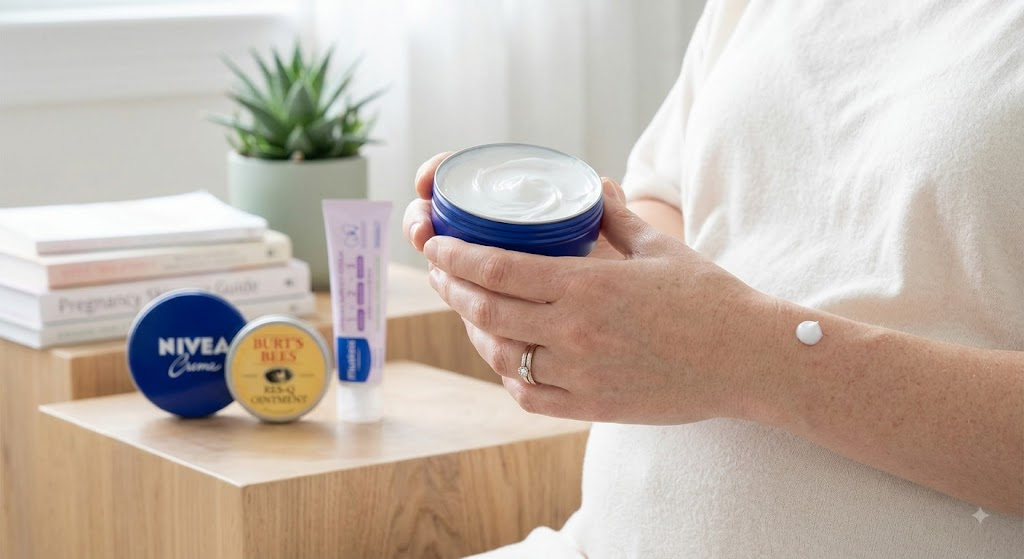
Mustela stands out because it specifically formulates products for pregnancy and babies. The brand goes beyond European regulations, which are already among the strictest in the world. Mustela products intended for babies and expectant mothers do not contain essential oils or alcohol.
Mustela excludes proven endocrine disruptors from all formulas. Each product is tested by an independent scientific laboratory. Every product undergoes over 450 measurements and tests before it can be sold. An independent toxicologist validates each formula and checks its safety for babies and expectant mothers.
Mustela products exclude parabens, phthalates, phenoxyethanol, bisphenol A and S, caffeine, and alcohol. Mustela Stretch Marks Prevention Oil can be used from the first month of pregnancy. The brand’s pregnancy creams are dermatologically tested and compatible with breastfeeding.
EWG Skin Deep rates Mustela Stretch Marks Prevention Cream with low developmental toxicity. Mustela is often the strongest pick for simple baby-style body care and barrier support. If you want pregnancy-specific formulas without doing your own label research, Mustela is the safest bet.
Nivea vs Burt’s Bees vs Mustela: Head-to-Head Comparison
When you ask “I’m a pregnant woman. Are Nivea products safe compared to Burt’s Bees or Mustela?” the answer depends on what you are buying.
For lip care: All three brands have safe options. Nivea Original lip balm, Burt’s Bees Beeswax lip balm, and basic lip products from all three are generally considered safe. Burt’s Bees is often easiest around lip care.
For body moisturizers: Nivea basic body lotions are generally low-risk. Burt’s Bees Mama Belly Butter is specifically formulated for pregnancy. Mustela’s pregnancy body care is clinically tested for safety.
For stretch mark prevention: Mustela has dedicated stretch mark products tested from the first month of pregnancy. Burt’s Bees offers belly butter for stretching skin. Nivea does not have a specific pregnancy stretch mark line.
For sunscreen: This needs checking across all brands. Mineral SPF with zinc oxide is the safest choice. Chemical sunscreens need formula-level review.
For anti-aging products: Avoid these across all three brands during pregnancy. Retinoids and exfoliating actives are not recommended.
How to Check Any Product Yourself
You do not need to memorize every ingredient. Here is a simple checklist:
Step 1: Look for retinoids (retinol, retinyl palmitate, tretinoin, adapalene). If you see these, put the product back.
Step 2: Check for hydroquinone. Avoid it.
Step 3: Look at the sunscreen filters. Choose mineral (zinc oxide, titanium dioxide) over chemical (oxybenzone, avobenzone).
Step 4: Check for parabens (methylparaben, ethylparaben, propylparaben, butylparaben). These are best avoided.
Step 5: Look for phthalates. Avoid products with “phthalate” in the name.
Step 6: Trust your nose. If a product is heavily fragranced, it may cause reactions even if ingredients are safe.
Step 7: Use resources like EWG Skin Deep to check product ratings. They score products for developmental and reproductive toxicity.
What the Experts Say
The American Academy of Dermatology (AAD) and the American College of Obstetricians and Gynecologists (ACOG) both point to the same handful of ingredients worth checking. They do not recommend avoiding entire brands. They recommend avoiding specific ingredients.
The FDA does not ban most skincare ingredients during pregnancy. Instead, experts recommend a precautionary approach. If an ingredient has any question mark, skip it.
Dermatologists agree that most basic moisturizers, gentle cleansers, and mineral sunscreens are safe during pregnancy. The risk comes from active ingredients designed to change skin — anti-aging creams, skin lighteners, acne treatments, and chemical exfoliants.
Frequently Asked Questions
Most basic Nivea creams are considered low-risk during pregnancy. EWG rates many Nivea products with low developmental toxicity. However, check the specific product label. Avoid Nivea products with retinoids, hydroquinone, or certain chemical sunscreens. If you want a product specifically tested for pregnancy, Burt’s Bees Mama Belly Butter or Mustela pregnancy creams are better choices.
Yes. Burt’s Bees Beeswax lip balm is generally considered safe during pregnancy. EWG rates it with low developmental toxicity and low allergies concerns. Basic lip balms from Burt’s Bees are among the safest choices. Just avoid heavily flavored or tinted versions if you want to be extra cautious.
Yes. Mustela products are tested for safety throughout pregnancy. Mustela Stretch Marks Prevention Oil can be used from the first month. The brand excludes ingredients that are concerning during pregnancy, including parabens, phthalates, and phenoxyethanol. Mustela is one of the most thoroughly tested pregnancy skincare brands available.
Mustela is the safest overall because it specifically formulates for pregnancy and undergoes extensive testing. Burt’s Bees is next, especially with their Mama Bee line. Nivea is safe for basic products but requires more careful label checking. None of these brands are automatically safe or automatically unsafe. The specific product matters more than the brand.
Avoid retinoids (retinol, retinyl palmitate, tretinoin, adapalene), hydroquinone, and high-dose salicylic acid. Also avoid chemical sunscreens with oxybenzone or avobenzone when possible. Parabens and phthalates are best avoided too. If you are unsure, ask your OB-GYN or dermatologist.
Check the ingredient list. Look for the ingredients mentioned above. Use EWG Skin Deep to check the product’s rating. Stick to basic moisturizers, gentle cleansers, and lip balms. Avoid anti-aging, skin-lightening, or acne-treatment products from Nivea. When in doubt, choose a product specifically marketed for pregnancy, like Mustela or Burt’s Bees Mama line.
Conclusion
So, “I’m a pregnant woman. Are Nivea products safe compared to Burt’s Bees or Mustela?”
The honest answer is that all three brands can be safe — and all three can contain products you should avoid. Mustela is the strongest choice if you want pregnancy-specific formulas without doing your own research. Burt’s Bees offers excellent natural options, especially the Mama Belly Butter. Nivea is safe for basic products but requires more careful label checking.
The golden rule of pregnancy skincare is this: check the product, not just the brand. A familiar brand can still make very different products. Read ingredient lists. Avoid retinoids, hydroquinone, and questionable preservatives. Choose gentle, basic formulas over active treatments.
Your skin is changing every day. Your skincare should support you, not stress you out. Take a deep breath, read those labels, and choose what feels right for you and your baby. And always talk to your OB-GYN or dermatologist before changing your routine — especially in the first trimester.
You have got this, mama. Your glow is coming.