Building software without clear instructions can waste time, create security risks, and lead to expensive mistakes. If you want to develop oxzep7 software, your first challenge is understanding what Oxzep7 actually refers to. Public descriptions use the name inconsistently, and the available evidence does not establish one universally recognized development framework under that name. This guide explains how to verify the project, choose suitable tools, plan features, write maintainable code, and launch a secure application without relying on unverified claims.
How Do You Develop Oxzep7 Software?
To develop oxzep7 software, first identify the project and obtain its official specifications, if they exist. Next, define the application’s purpose, choose an appropriate programming language and architecture, build a small working version, test its features, protect its data, and deploy it in a controlled environment.
There is no verified, universal Oxzep7 installation process or official technology stack established by the public information reviewed for this guide. The steps below therefore cover established software engineering practices that you can apply to a verified Oxzep7 project or a custom application using that name.
What Is Oxzep7 Software?
The term “Oxzep7 software” does not have one consistently verified technical definition in the public sources reviewed. Some websites describe it as a development framework, while others discuss it as a custom application or automation concept. These descriptions are not enough to establish an official product specification.
Before you develop oxzep7 software, determine which situation applies to your project:
- Public software product: A tool with an identifiable publisher, official documentation, and supported releases.
- Private business application: Software maintained by a company for its own operations.
- Custom development project: An application whose name comes from a client, team, or project owner.
- Project codename: A temporary name used during development.
- Unverified technology term: A name used online without a clearly established technical identity.
The distinction matters because each situation requires different installation instructions, dependencies, and development tools.
How can you verify the software?
Look for these details before writing code:
- An official website or product owner.
- Technical documentation and installation instructions.
- A source-code repository, where applicable.
- Package registry information, if it is distributed as a package.
- Supported versions and system requirements.
- A license, release history, and maintenance information.
- A way to contact the developer or report issues.
If these details are unavailable, treat Oxzep7 as an unverified project name rather than assuming that it is an established framework.
Why Should You Verify Oxzep7 Before Development?
Choosing a technology based on incomplete information can cause problems throughout a project. You might install an unrelated package, follow commands that do not work, or build an application around features that do not exist.
A careful verification process reduces these risks and helps you choose a suitable development path.
Consider these common warning signs:
- A tutorial gives installation commands but does not identify the package publisher.
- Different websites describe completely different features.
- The supposed official documentation has no version history.
- Download links lead to unfamiliar websites.
- An article claims a product is secure without explaining how security was tested.
- No identifiable developer or organization maintains the project.
These warning signs do not prove that a private project is illegitimate. They indicate that you need stronger evidence before trusting its technical claims.
For Python projects, the Python Packaging User Guide explains standard package metadata, including a package’s name and version. This is a useful starting point when checking whether a claimed Python package has identifiable distribution information.
What Are the Main Requirements for Oxzep7 Development?
Every successful software project starts with a clear purpose. Before you develop oxzep7 software, write down what the application must do, who will use it, and what results it should deliver.
For example, imagine Oxzep7 is the internal name of a small business management application. Its first version might allow employees to sign in, manage records, search information, and generate reports.
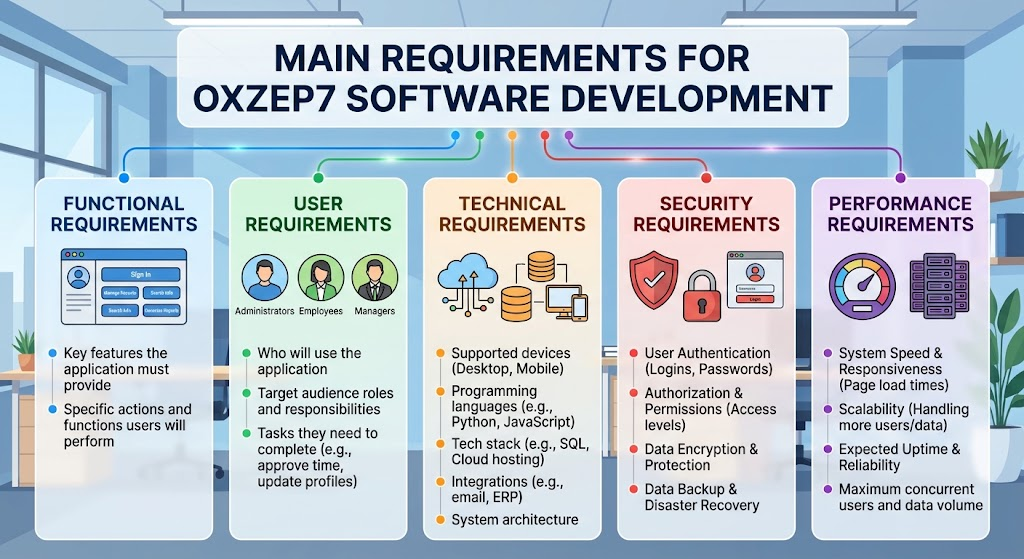
Your requirements should cover five areas:
- Functional requirements: Features the application must provide.
- User requirements: Who will use it and what tasks they need to complete.
- Technical requirements: Supported devices, programming languages, integrations, and hosting.
- Security requirements: Authentication, permissions, data protection, and recovery.
- Performance requirements: Expected response times, user numbers, and data volume.
Example requirements table
| Requirement | Example | How to verify it |
| User login | Users sign in securely | Test valid and invalid credentials |
| Dashboard | Users see relevant records | Check data accuracy and loading |
| Search | Users find records by keyword | Test matching and missing results |
| Data storage | Records remain available | Save, retrieve, and restore test data |
| Permissions | Users access permitted features only | Test different account roles |
| Reporting | Users export selected information | Compare exported results with stored data |
| Reliability | Errors are handled properly | Test failures and recovery |
| Accessibility | Controls work for different users | Review keyboard navigation and labels |
These are illustrative requirements, not confirmed built-in features of Oxzep7.
Which Programming Language Should You Choose?
The right programming language depends on the application you intend to build. There is no verified official language requirement for Oxzep7 that can be applied to every project.
Here is a practical comparison of common options.
| Language | Best suited for | Useful considerations |
| Python | Automation, APIs, data processing, and backend services | Readable syntax and a large package ecosystem |
| JavaScript | Interactive websites and server-side applications | Supports development across browser and server environments |
| TypeScript | Larger web applications | Adds static type checking to JavaScript |
| Java | Enterprise applications and backend services | Established tooling and mature libraries |
| C# | Business applications, APIs, and .NET systems | Strong development tools within the .NET ecosystem |
| Go | Network services and backend systems | Compiled applications and built-in concurrency features |
Which language is best for beginners? Python is a reasonable starting point for automation and backend projects, while JavaScript is useful when your primary goal is building interactive websites.
If you need to develop oxzep7 software for an existing organization, follow its actual technical requirements instead of changing languages simply because another option is popular.
Which Development Tools Do You Need?
Your toolset should support coding, collaboration, testing, and deployment without adding unnecessary complexity.
Suggested tools for a custom software project; these are not official Oxzep7 dependencies.
| Tool | Purpose | Example |
| Code editor | Write and review source code | Visual Studio Code |
| Version control | Track code changes | Git |
| Code hosting | Store and share repositories | GitHub |
| Runtime | Execute application code | Python or Node.js |
| Dependency manager | Install and manage libraries | pip or npm |
| Database | Store application data | PostgreSQL or SQLite |
| Automated testing | Check expected behavior | pytest or a suitable test framework |
| API testing | Test application endpoints | An API client or automated test suite |
| Deployment platform | Host the finished application | A suitable cloud or managed server |
| Monitoring | Track errors and availability | Application logs and monitoring tools |
For example, GitHub’s official repository documentation explains how repositories store project files and revision history. Version control helps you review changes, collaborate safely, and return to a known working version.
Start with a small toolset. Add new services only when the project needs them.
How Do You Develop Oxzep7 Software Step by Step?
The following workflow provides a practical path from an initial idea to a tested application.
Step 1: Identify the project
Confirm the name, owner, documentation, purpose, and existing code. If Oxzep7 is a private project, obtain its internal specifications.
Step 2: Define the first version
Select two or three essential features. Write down what users should be able to do and how you will measure success.
Step 3: Design the architecture
Decide how the interface, application logic, database, and external services will communicate. Keep the initial design simple.
Step 4: Build a working prototype
Implement one complete user task, such as creating a record and displaying it on a dashboard. Avoid building every feature at once.
Step 5: Add security and tests
Validate inputs, protect credentials, check permissions, and test both successful actions and failure cases.
Step 6: Deploy and monitor
Test the application in a staging environment, back up important data, release carefully, and monitor errors after launch.
What should you build first?
Build a minimum viable product (MVP): the smallest usable version that solves the main problem.
For a basic record-management application, the first release might include:
- A simple login screen.
- A form to add a record.
- A page to view saved records.
- A search function.
- Basic error messages.
- A reliable way to store and back up data.
Once these features work correctly, you can add advanced reporting, integrations, notifications, or automation.
How Should You Design the Software Architecture?
Architecture describes how different parts of an application fit together. A clear design makes it easier to fix bugs, add features, and understand how information moves through the system.
For a small web application, a three-layer structure is often a sensible starting point.
Presentation layer
Pages, forms, buttons, and dashboards
Application layer
Business rules, validation, authentication, and APIs
Data layer
Database queries, storage, backups, and data access
Each layer has a separate responsibility:
- The presentation layer displays information and accepts user actions.
- The application layer checks rules and processes requests.
- The data layer stores and retrieves information.
For a small application, these layers can live in one codebase. A larger system might require separate services, but splitting everything into microservices from the beginning usually adds unnecessary work.
If you develop oxzep7 software for a large organization, choose an architecture based on real requirements, expected traffic, maintenance resources, and security obligations.
How Do You Set Up a Python Development Environment?
Python is one possible choice for a custom application, particularly when you need automation, data processing, or a backend API. The commands below are for a new Python project, not verified Oxzep7 installation commands.
First, install Python from its official website and confirm that it is available on your computer.
Create a project directory and open a terminal inside it.
On Windows:
mkdir oxzep7-project
cd oxzep7-project
py -m venv .venv
.venv\Scripts\activate
On macOS or Linux:
mkdir oxzep7-project
cd oxzep7-project
python3 -m venv .venv
source .venv/bin/activate
Next, create a basic Python file called main.py:
def main(): print(“Custom application is running.”)if __name__ == “__main__”: main()
Run the program:
python main.py
If the terminal displays Custom application is running., your basic Python environment is working.
What about installing Oxzep7 with pip?
Do not assume that pip install oxzep7 is the correct command. Use it only if you have verified the exact package name and its publisher through an authoritative source.
If you are creating your own Python package, the Python Packaging User Guide explains how to define project metadata and dependencies using pyproject.toml.
How Should You Design the Database?
A database keeps application information organized and available. Your choice depends on the amount of data, number of users, access patterns, and reliability requirements.
| Database | Suitable use | Main consideration |
| SQLite | Small applications and local prototypes | Simple setup with limited infrastructure |
| PostgreSQL | Multi-user applications and structured business data | Requires appropriate configuration and maintenance |
| MySQL | Websites and business applications | Needs careful user permissions and backups |
| MongoDB | Applications that benefit from document-oriented data | Data structure and validation require planning |
| Redis | Caching, queues, and temporary data | Usually complements rather than replaces a primary database |
For a basic application, start by identifying the information you need to store.
A simple records table might contain:
| Field | Example type | Purpose |
| id | Integer or UUID | Unique record identifier |
| name | Text | Record name |
| created_at | Timestamp | Creation date and time |
| updated_at | Timestamp | Most recent change |
| status | Text or enum | Current record state |
| owner_id | Integer or UUID | Associated user |
These fields are examples, not a required Oxzep7 schema.
Use database constraints to prevent invalid records. Apply appropriate access controls, keep backups, and test whether you can restore data before depending on the application in production.
How Can You Make Oxzep7 Software Secure?
Security should be part of development from the start, not a task left until launch. Even a small application can expose personal information, business records, or login credentials if developers overlook basic protections.
Use these safeguards:
- Authentication: Verify a user’s identity before granting access.
- Authorization: Restrict actions according to the user’s role.
- Input validation: Reject unexpected or malformed data.
- Password protection: Use established password-hashing methods rather than storing plain-text passwords.
- Secret management: Keep API keys and database credentials out of public source code.
- Encrypted connections: Use HTTPS for web traffic.
- Dependency checks: Review third-party packages and update vulnerable dependencies.
- Backups: Protect backups and periodically test restoration.
- Logging: Record useful security events without exposing passwords or sensitive information.
- Access reviews: Remove permissions that users no longer need.
The OWASP Application Security Verification Standard provides an established set of requirements for assessing web application security. It can help developers turn general security advice into testable controls.
If you develop oxzep7 software for healthcare, financial services, or another sensitive field, identify the relevant legal, contractual, and industry-specific requirements before collecting real user data.
How Do You Test the Application Before Launch?
Testing helps you discover defects before they affect users. A program that runs without displaying an error is not necessarily correct, secure, or ready for release.
Use several types of testing.
| Test type | What it checks | Example |
| Unit testing | Individual functions | Does a calculation return the correct result? |
| Integration testing | Communication between components | Does the API save data correctly? |
| Functional testing | Required user workflows | Can a user create and update a record? |
| Security testing | Access controls and vulnerabilities | Can an unauthorized user view private data? |
| Performance testing | Behavior under expected workload | Does the application respond adequately to concurrent requests? |
| Compatibility testing | Supported browsers and devices | Does the interface work on mobile and desktop? |
| User acceptance testing | Whether the application meets real needs | Can intended users complete their tasks? |
| Recovery testing | Ability to recover from failures | Can a verified backup restore missing records? |
Create a practical testing checklist
Before releasing a custom application, verify that:
- All essential features work as specified.
- Invalid inputs produce understandable errors.
- Users cannot access restricted records.
- Data remains correct after updates.
- Dependencies install in a clean environment.
- Logs help developers investigate failures.
- Backups can be restored successfully.
- The application works in its supported environments.
- A rollback plan exists for failed releases.
Automate repeatable tests whenever practical. Run them after important code changes so that a new feature does not silently break an existing one.
How Do You Deploy and Maintain the Software?
Deployment makes the application available to its intended users. A reliable release process separates development, testing, and production so that experimental changes do not immediately affect live operations.
A practical release process looks like this:
- Commit reviewed changes to version control.
- Run automated tests and dependency checks.
- Build the application using documented steps.
- Deploy it to a staging environment.
- Test the main workflows and integrations.
- Back up important production data.
- Release the approved version.
- Monitor logs, errors, availability, and performance.
- Roll back if a serious issue appears.
- Document the release and plan follow-up fixes.
What maintenance should you schedule?
| Frequency | Recommended task |
| Daily or as needed | Review critical errors and service availability |
| Weekly | Review failed jobs, alerts, and recent changes |
| Monthly | Review dependencies, access permissions, and backup status |
| Each release | Run regression tests and security checks |
| Periodically | Test disaster recovery and review system capacity |
The exact schedule depends on the application’s risk and usage. Systems handling important business operations may require more frequent reviews and stronger monitoring.
To develop oxzep7 software that remains useful over time, assign responsibility for updates, bug fixes, documentation, and incident response before the first production release.
What Are the Most Common Oxzep7 Development Mistakes?
Many software problems begin with assumptions made before the first line of code. Avoiding these mistakes can save time and make your application easier to maintain.
| Common mistake | Why it causes problems | Better approach |
| Assuming Oxzep7 is a verified framework | You may follow incorrect instructions | Confirm its identity first |
| Choosing tools before defining requirements | The technology may not fit the project | Start with the intended outcome |
| Building too many features at once | Testing and debugging become harder | Release a small working version |
| Ignoring security | Data and accounts may be exposed | Include security checks from the beginning |
| Skipping automated tests | Changes can introduce hidden bugs | Test important functions regularly |
| Installing unknown packages | Dependencies may introduce security risks | Verify package identity and publisher |
| Keeping secrets in source code | Credentials may be exposed | Use appropriate secret management |
| Deploying without backups | Failures may cause data loss | Test backups and recovery procedures |
| Neglecting documentation | Future maintenance becomes difficult | Document setup, decisions, and releases |
The most important rule is simple: do not confuse a detailed online tutorial with verified product documentation. Apply proven development practices, but confirm every Oxzep7-specific instruction before relying on it.
What Is the Best Development Plan for Beginners?
If you are new to software development, divide the project into manageable stages. This approach makes it easier to learn, measure progress, and avoid spending time on unnecessary features.
Here is an example eight-week plan for a small custom application.
| Week | Main task | Expected result |
| 1 | Verify the project and define requirements | Written project specification |
| 2 | Learn the required language and tools | Working development environment |
| 3 | Design the interface and data structure | Basic application design |
| 4 | Build the main feature | Functional prototype |
| 5 | Add data storage and validation | Working data operations |
| 6 | Add authentication and security controls | Protected application |
| 7 | Test workflows and fix defects | Release candidate |
| 8 | Deploy, document, and monitor | Initial release |
This timeline is an example, not a guaranteed delivery schedule. Complex integrations, unfamiliar technologies, and strict security requirements can increase development time.
If your goal is to develop oxzep7 software as a personal learning project, start with one feature and complete it before adding another. If you are working with an existing team, use its approved architecture and release process instead.
Frequently Asked Questions
It refers to creating or working on a software project associated with the Oxzep7 name. Its exact technical meaning remains unclear in the public sources reviewed, so confirm the project specifications before choosing tools or writing code.
The available evidence does not establish Oxzep7 as a universally recognized development framework with one official specification. Look for documentation, an identifiable publisher, a maintained repository, and verified release information before adopting it.
Yes, beginners can build a custom application using established programming tools if they understand the project’s requirements. Start with basic programming, a small prototype, simple data storage, and repeatable tests rather than assuming Oxzep7 has ready-made features.
There is no verified universal programming language requirement for Oxzep7. Python suits many automation and backend projects, while JavaScript or TypeScript works well for interactive web applications. Choose according to the actual requirements.
Only if you verify that the project is distributed as a Python package under the exact name you intend to use. Check the package publisher, version, dependencies, and documentation before running installation or upgrade commands.
Start by saving the full error message and traceback. Check the runtime version, active environment, dependencies, configuration, permissions, and relevant logs. Reproduce the problem in a test environment before changing a production system.
Conclusion
To develop oxzep7 software successfully, begin by confirming what Oxzep7 represents and identifying the requirements that your application must meet. The public information reviewed does not establish one standard Oxzep7 framework, installation method, or technology stack, so avoid presenting unverified commands and features as official instructions.
Build a small prototype, select technologies that fit your actual needs, organize your code carefully, and include testing, security, documentation, and maintenance in the development plan. These practical steps provide a dependable foundation for a custom software project, whether Oxzep7 turns out to be an internal product name or a concept that needs further clarification.