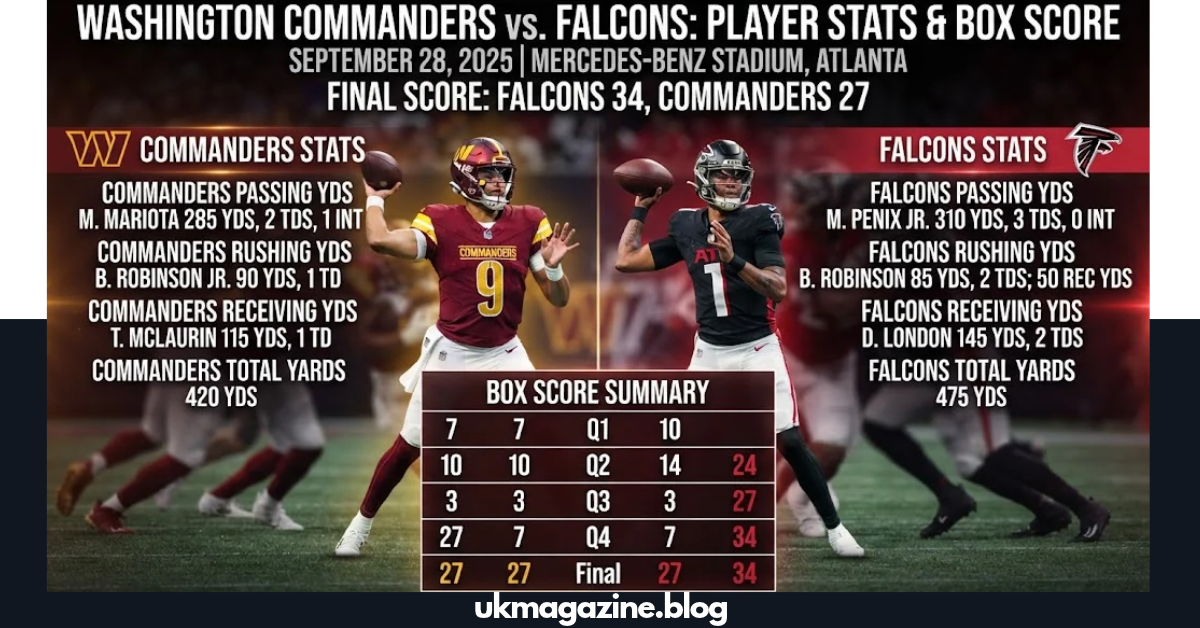
The Washington Commanders and Atlanta Falcons met on September 28, 2025, at Mercedes-Benz Stadium in Atlanta. The Falcons won 34–27 after building an early lead and maintaining enough scoring pressure to stay ahead through the fourth quarter.
For fans checking washington commanders vs atlanta falcons match player stats, the box score highlights Michael Penix Jr.’s passing performance, Drake London’s receiving production, Bijan Robinson’s contribution on the ground and through the air, and Marcus Mariota’s two passing touchdowns for Washington. These numbers provide a clear picture of how the game unfolded.
Washington Commanders vs Atlanta Falcons Match Player Stats: Final Score
| Game Detail | Washington Commanders | Atlanta Falcons |
| Final Score | 27 | 34 |
| First Quarter | 0 | 10 |
| Second Quarter | 10 | 7 |
| Third Quarter | 6 | 14 |
| Fourth Quarter | 11 | 3 |
| Total Net Yards | 294 | 435 |
| Time of Possession | 25:45 | 34:15 |
| Penalties | 6 | 5 |
| Penalty Yards | 50 | 45 |
| Venue | Mercedes-Benz Stadium | Mercedes-Benz Stadium |
| Game Date | September 28, 2025 | September 28, 2025 |
Atlanta finished with 141 more net yards than Washington. The Falcons also controlled possession for 8 minutes and 30 seconds longer, giving their offense more time to work through its drives.
Source: Washington Commanders Official Box Score.
Quarterback Player Stats
Quarterback production played a major role in the matchup. Michael Penix Jr. delivered more passing yards for Atlanta, while Marcus Mariota recorded two passing touchdowns for Washington.
| Quarterback | Team | Completions | Attempts | Completion Rate | Passing Yards | TD Passes | Interceptions |
| Michael Penix Jr. | Atlanta Falcons | 20 | 26 | 76.9% | 313 | 2 | 1 |
| Marcus Mariota | Washington Commanders | 16 | 27 | 59.3% | 156 | 2 | 1 |
Completion rates are calculated from the recorded completions and attempts.
Michael Penix Jr. Passing Performance
Penix completed 20 of 26 passes for 313 yards, two touchdowns, and one interception. His passing total gave Atlanta a substantial advantage in the air.
His longest recorded pass play was 69 yards, according to the game statistics. That big-play production helped Atlanta generate 435 total net yards.
Marcus Mariota Passing Performance
Mariota completed 16 of 27 attempts for 156 yards, two touchdowns, and one interception. His touchdown passes connected with Luke McCaffrey and Deebo Samuel.
Washington continued to score in the fourth quarter, but the team could not close the seven-point gap before the final whistle.
Washington Commanders Rushing Stats
Washington used several players in its rushing attack. Chris Rodriguez produced the team’s longest run, while Jacory Croskey-Merritt added another contribution to the ground game.
| Player | Rushing Attempts | Rushing Yards | Longest Run | Rushing Touchdowns |
| Chris Rodriguez | 7 | 59 | 48 yards | 0 |
| Jacory Croskey-Merritt | 7 | 47 | 16 yards | 0 |
| Marcus Mariota | 2 | 20 | 22 yards | 0 |
| Deebo Samuel | 3 | 9 | 7 yards | 0 |
| Chris Moore | 1 | 9 | 9 yards | 0 |
| Jeremy McNichols | 2 | 3 | 2 yards | 0 |
| Total | 22 | 147 | — | 0 |
Chris Rodriguez’s 48-yard run was Washington’s longest rushing play in the game. However, the Commanders did not record a rushing touchdown in this matchup.
These rushing figures help explain the balance between Washington’s passing and running offense when reviewing washington commanders vs atlanta falcons match player stats.
Atlanta Falcons Rushing Stats
Atlanta distributed rushing opportunities between Bijan Robinson, Tyler Allgeier, and Penix. Robinson and Allgeier each scored a rushing touchdown.
| Player | Rushing Attempts | Rushing Yards | Longest Run | Rushing Touchdowns |
| Bijan Robinson | 17 | 75 | 14 yards | 1 |
| Tyler Allgeier | 16 | 51 | 19 yards | 1 |
| Michael Penix Jr. | 4 | 2 | 5 yards | 0 |
| Total | 37 | 128 | — | 2 |
Robinson scored on a 14-yard rushing play in the second quarter. Allgeier added a 15-yard touchdown run in the third quarter, helping Atlanta extend its lead.
Atlanta’s running backs also gave the offense options beyond passing, keeping Washington’s defense occupied throughout the game.
Washington Commanders Receiving Stats
Deebo Samuel led Washington’s receiving group with 72 yards and one touchdown. Luke McCaffrey also recorded a touchdown reception, while Zach Ertz contributed catches in the passing game.
| Player | Receptions | Receiving Yards | Longest Reception | Receiving Touchdowns |
| Deebo Samuel | 6 | 72 | 24 yards | 1 |
| Zach Ertz | 2 | 21 | 14 yards | 0 |
| Luke McCaffrey | 2 | 21 | 16 yards | 1 |
| Jaylin Lane | 2 | 18 | 11 yards | 0 |
| Tay Martin | 1 | 14 | 14 yards | 0 |
| Jacory Croskey-Merritt | 2 | 10 | 6 yards | 0 |
| Jeremy McNichols | 1 | 0 | 0 yards | 0 |
Samuel’s touchdown came on a 24-yard reception from Mariota in the fourth quarter. Washington also completed a two-point conversion on the same scoring play, keeping the Commanders within reach.
The receiving numbers show that Washington relied on multiple targets rather than one player for all its passing production.
Atlanta Falcons Receiving Stats
Drake London led Atlanta in receiving yards and receptions. Robinson also made a significant contribution as a receiving target, finishing with 106 receiving yards.
| Player | Receptions | Receiving Yards | Longest Reception | Receiving Touchdowns |
| Drake London | 8 | 110 | 43 yards | 1 |
| Bijan Robinson | 4 | 106 | 69 yards | 0 |
| Kyle Pitts | 5 | 70 | 26 yards | 1 |
| Casey Washington | 1 | 19 | 19 yards | 0 |
| Darnell Mooney | 1 | 15 | 15 yards | 0 |
| Ray-Ray McCloud | 1 | -7 | -7 yards | 0 |
London caught eight passes for 110 yards and one touchdown. Pitts added a touchdown reception, while Robinson’s 106 receiving yards demonstrated his impact outside the rushing game.
Robinson’s 69-yard reception was the longest recorded reception for either team in this game. His combined rushing and receiving production made him an important part of Atlanta’s offensive output.
Washington vs Atlanta Offensive Comparison
The following table brings together the major offensive figures from the game.
| Offensive Category | Washington Commanders | Atlanta Falcons |
| Passing Completions | 16 | 20 |
| Passing Attempts | 27 | 26 |
| Passing Yards | 156 | 313 |
| Passing Touchdowns | 2 | 2 |
| Interceptions Thrown | 1 | 1 |
| Rushing Attempts | 22 | 37 |
| Rushing Yards | 147 | 128 |
| Rushing Touchdowns | 0 | 2 |
| Total Net Yards | 294 | 435 |
| Total Points | 27 | 34 |
Rushing totals include quarterback rushing attempts. Total net yards are the official team figures and should not be calculated by simply adding passing and rushing yards, because official net totals account for factors such as sack yardage.
Atlanta generated substantially more passing yardage and recorded two rushing touchdowns. Washington produced more rushing yards in this particular box-score breakdown, but Atlanta’s combined offensive production resulted in more total net yards.
Quarter-by-Quarter Scoring Summary
The scoring timeline shows when each team built and reduced the gap.
| Quarter | Washington Commanders | Atlanta Falcons | Key Events |
| First | 0 | 10 | Atlanta field goal and Drake London touchdown |
| Second | 10 | 7 | Washington touchdowns and field goal; Bijan Robinson rushing touchdown |
| Third | 6 | 14 | Washington field goals; Atlanta touchdowns by Kyle Pitts and Tyler Allgeier |
| Fourth | 11 | 3 | Deebo Samuel touchdown and two-point conversion; field goals by both teams |
| Final | 27 | 34 | Atlanta won by seven points |
Atlanta established a 10-point lead in the opening quarter. Washington scored 10 points in the second quarter, but Atlanta entered halftime ahead 17–10.
The Falcons extended their advantage in the third quarter with two touchdowns. Washington responded in the final quarter, but Atlanta’s field goal helped maintain the lead.
Key Touchdowns and Scoring Plays
The game featured passing touchdowns, rushing touchdowns, field goals, and a successful two-point conversion.
| Team | Player | Scoring Play | Quarter |
| Atlanta Falcons | John Parker Romo | 38-yard field goal | First |
| Atlanta Falcons | Drake London | 5-yard touchdown reception | First |
| Washington Commanders | Luke McCaffrey | 5-yard touchdown reception | Second |
| Atlanta Falcons | Bijan Robinson | 14-yard rushing touchdown | Second |
| Washington Commanders | Matt Gay | 43-yard field goal | Second |
| Washington Commanders | Matt Gay | 52-yard field goal | Third |
| Atlanta Falcons | Kyle Pitts | 7-yard touchdown reception | Third |
| Washington Commanders | Matt Gay | 41-yard field goal | Third |
| Atlanta Falcons | Tyler Allgeier | 15-yard rushing touchdown | Third |
| Washington Commanders | Deebo Samuel | 24-yard touchdown reception | Fourth |
| Washington Commanders | Zach Ertz | Two-point conversion reception | Fourth |
| Atlanta Falcons | John Parker Romo | 26-yard field goal | Fourth |
| Washington Commanders | Matt Gay | 42-yard field goal | Fourth |
Washington’s fourth-quarter touchdown reduced the margin, but the Commanders could not complete the comeback. Atlanta’s final field goal preserved the seven-point difference.
Team Statistics and Possession Analysis
Team statistics help explain the result beyond individual player numbers.
| Team Statistic | Washington | Atlanta |
| Total Net Yards | 294 | 435 |
| Penalties | 6 | 5 |
| Penalty Yards | 50 | 45 |
| Time of Possession | 25:45 | 34:15 |
| Final Points | 27 | 34 |
Atlanta’s 435 net yards reflected its ability to move the ball through both the passing game and its running backs. The Falcons also held possession for more than half an hour, giving their offense additional opportunities to score.
Washington committed six penalties for 50 yards, compared with Atlanta’s five penalties for 45 yards. The difference in penalties was relatively small compared with the difference in total net yards.
For readers researching washington commanders vs atlanta falcons match player stats, these team-level figures provide context for the individual performances.
Defensive Performance: What the Box Score Tells Us
Offensive statistics explain much of the scoring, but a complete football analysis also considers defense. Defensive tackles, sacks, interceptions, pass breakups, forced fumbles, and fumble recoveries can help show how teams disrupted opposing drives.
The headline team statistics above do not provide a complete defensive player-by-player breakdown. Readers who need individual defensive totals should consult the full official game box score rather than assume that a player’s defensive performance can be inferred from the final score.
When reviewing defensive figures, it is useful to separate:
- Tackles: Total stops credited to a defender.
- Sacks: Tackles of the quarterback behind the line of scrimmage on a passing play.
- Interceptions: Passes caught by the defense.
- Forced fumbles: Plays in which a defender causes an opponent to lose possession.
- Pass deflections: Plays in which a defender disrupts a pass without catching it.
These measurements offer additional context when comparing the two defenses.
What the Player Statistics Reveal About the Game
The box score points to several clear features of the matchup.
Atlanta’s Passing Production
Penix recorded 313 passing yards, nearly twice Mariota’s 156 yards. London led the receiving group with 110 yards, and Robinson added another 106 receiving yards.
Contributions from Atlanta’s Running Backs
Robinson rushed for 75 yards and a touchdown. Allgeier added 51 rushing yards and another touchdown, giving Atlanta two rushing scores.
Washington’s Fourth-Quarter Response
Samuel’s touchdown reception and the two-point conversion helped Washington continue its scoring effort late in the game. However, the Commanders remained seven points behind at the end.
The Difference in Total Yardage
Atlanta finished with 435 total net yards, compared with Washington’s 294. This difference provides important context for understanding how Atlanta maintained its advantage despite Washington’s late scoring.
These details make washington commanders vs atlanta falcons match player stats useful for fans, fantasy football research, and readers comparing individual performances across NFL games.
Historical Context and Head-to-Head Results
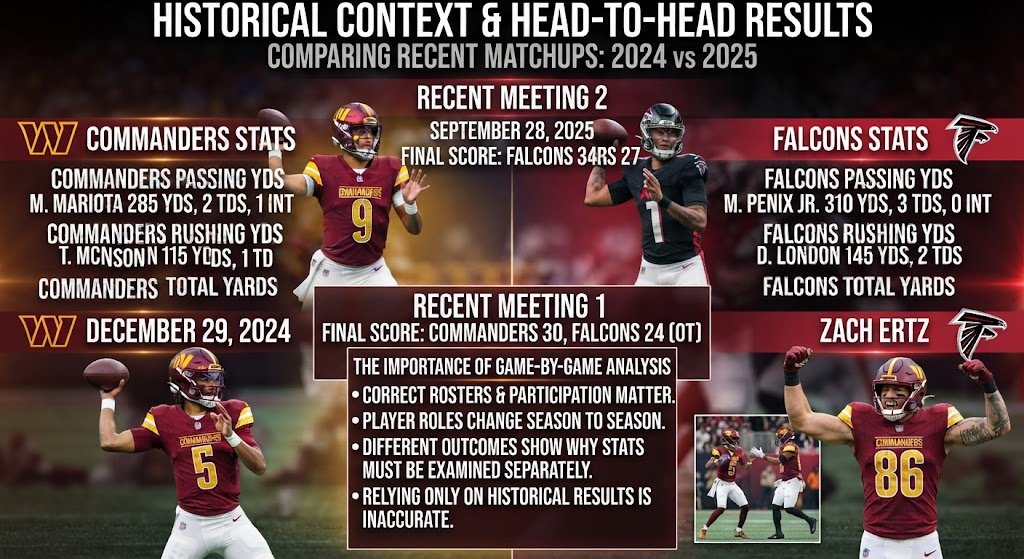
The September 28, 2025 matchup was not the only recent meeting between these teams. Washington and Atlanta also played on December 29, 2024, when Washington won 30–24 in overtime.
In that earlier game, Jayden Daniels threw the game-winning touchdown pass to Zach Ertz in overtime. The different outcomes across the two meetings illustrate why each game’s player statistics should be examined separately instead of relying only on historical results.
For accurate comparisons, use the correct game date, player roster, and season. Players’ roles, participation, and statistical production can change from one meeting to the next.
Where to Find Official Match Player Stats
For readers who want to verify or explore additional figures, the following sources provide relevant game information.
- Washington Commanders official game center: The September 28, 2025 box score includes the scoring summary, passing, rushing, receiving, and team statistics.
- Pro-Football-Reference: The historical box score provides detailed player statistics, scoring plays, and game information.
- NFL.com: The NFL’s game recap provides additional context about the matchup and Washington’s late scoring effort.
These sources are useful for checking numbers before using them in fantasy football analysis, game recaps, or historical comparisons.
Frequently Asked Questions
The Atlanta Falcons won 34–27 at Mercedes-Benz Stadium. Atlanta led 17–10 at halftime and maintained its advantage through the fourth quarter.
Michael Penix Jr. completed 20 of 26 passes for 313 yards, two touchdowns, and one interception. Marcus Mariota completed 16 of 27 passes for 156 yards, two touchdowns, and one interception.
Michael Penix Jr. led both teams with 313 passing yards. His passing production helped Atlanta finish with 435 total net yards.
Drake London led all listed receivers with 110 receiving yards on eight catches. Bijan Robinson followed closely with 106 receiving yards on four catches.
Atlanta scored two rushing touchdowns, one by Bijan Robinson and one by Tyler Allgeier. Washington did not record a rushing touchdown in the game.
The official Washington Commanders game center provides the final score, team statistics, and offensive player figures. Pro-Football-Reference also provides a historical box score for the September 28, 2025 game.
Conclusion
The September 28, 2025 matchup ended with the Atlanta Falcons defeating the Washington Commanders 34–27. Michael Penix Jr. passed for 313 yards, Drake London led the receiving group with 110 yards, and Bijan Robinson contributed through both rushing and receiving. Washington received two passing touchdowns from Marcus Mariota and a fourth-quarter scoring contribution from Deebo Samuel.
The washington commanders vs atlanta falcons match player stats show how passing production, rushing touchdowns, total yardage, and possession contributed to the final result. For accurate NFL comparisons, readers should use the official game box score and check the specific date and season before drawing conclusions about player performance.