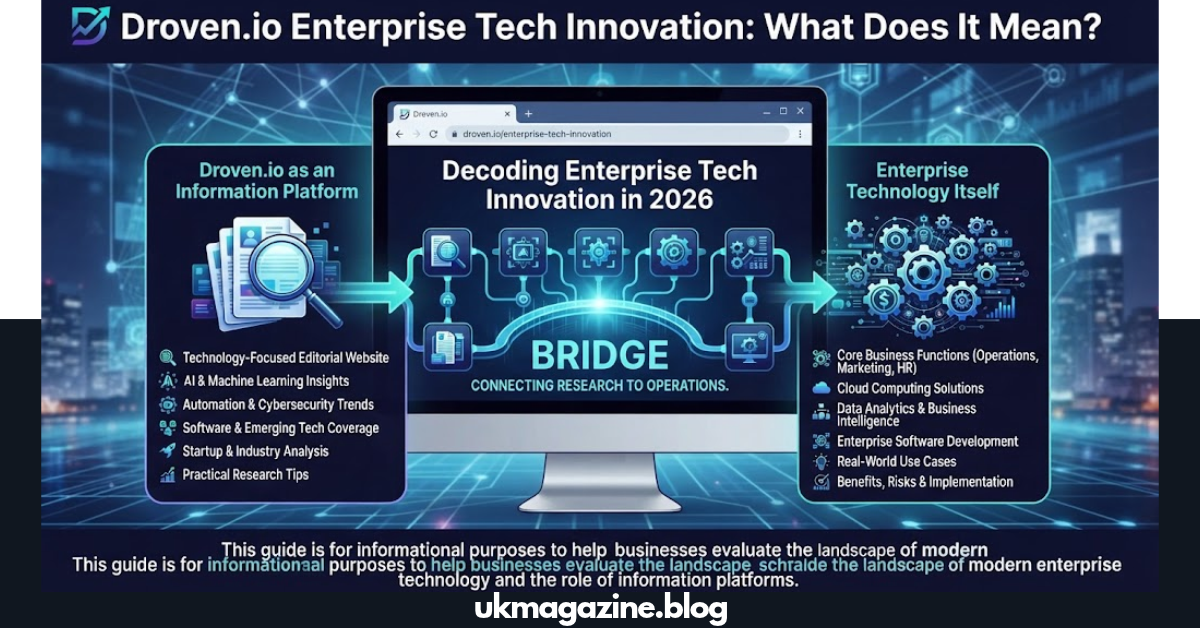
Businesses face a simple problem with a difficult answer: technology changes faster than most teams can evaluate it. AI, cloud computing, automation, cybersecurity, data analytics, and software development now affect almost every business function. Droven.io enterprise tech innovation is a useful search topic for understanding these technologies and how they connect to modern business operations.
The important point is to separate Droven.io as an information platform from enterprise technology itself. Publicly available information describes Droven.io primarily as a technology-focused editorial website covering areas such as AI, machine learning, automation, cybersecurity, software, startups, and emerging technology.
What Is Droven.io Enterprise Tech Innovation?
Droven.io enterprise tech innovation refers to the connection between Droven.io’s technology-focused content and the wider practice of using modern technology to improve business operations.
Droven.io should not automatically be treated as a SaaS application, cloud provider, or enterprise automation product. Current public information presents it mainly as an informational technology platform rather than a deployable enterprise system.
For business readers, this distinction matters. A technology publication can help someone understand a new technology, while the actual implementation may require separate software vendors, cloud infrastructure, developers, security controls, and internal processes.
Is Droven.io an Enterprise Software Product?
Short answer: public information currently points to Droven.io being an editorial technology platform rather than a conventional enterprise software product.
There is a meaningful difference between reading about enterprise technology and buying enterprise technology. A software product normally has documented features, deployment options, pricing, user administration, technical documentation, support processes, and security information.
The available descriptions of Droven.io focus instead on technology news, explainers, emerging technology, AI, automation, software development, and related subjects.
What Technologies Are Connected to Droven.io Enterprise Tech Innovation?
The wider enterprise innovation landscape includes several technology categories. These technologies often work together rather than operating as separate projects.
| Technology | Enterprise purpose | Common example |
| Artificial Intelligence | Automate analysis and support decisions | Customer-service assistants |
| Machine Learning | Find patterns in business data | Demand forecasting |
| Generative AI | Create and transform content | Document drafting |
| Cloud Computing | Provide scalable infrastructure | Cloud applications |
| Automation | Reduce repetitive manual work | Invoice processing |
| Cybersecurity | Protect systems and information | Identity controls |
| Data Analytics | Turn business data into insights | Sales dashboards |
| Software Development | Build digital products | Internal business applications |
| Robotics | Automate physical processes | Warehouse systems |
| Digital Transformation | Modernize connected operations | Cloud-based workflows |
These areas are also consistent with the broader subjects publicly associated with Droven.io.
How Artificial Intelligence Supports Enterprise Innovation
Artificial intelligence has become an important part of enterprise technology because it can process large amounts of information and assist with repetitive or knowledge-based tasks.
Businesses can use AI for customer support, document classification, search, forecasting, coding assistance, marketing workflows, fraud analysis, and internal knowledge systems.
However, adding AI to a business does not automatically create value. Organizations need clear use cases, quality data, appropriate access controls, testing, human oversight, and measurable business goals.
The National Institute of Standards and Technology (NIST) recommends managing AI risks throughout the AI lifecycle, including design, development, deployment, use, and evaluation.
Why Cloud Computing Matters
Cloud computing gives organizations access to computing, storage, databases, networking, and other services without requiring every workload to run on privately owned infrastructure.
For enterprise teams, cloud architecture can support scalability, reliability, security, and faster deployment. Google Cloud’s current Well-Architected Framework organizes cloud guidance around areas including operational excellence, security, reliability, cost optimization, performance, and sustainability.
A strong cloud strategy therefore involves more than moving existing systems to a cloud provider. Teams should consider architecture, identity, data protection, monitoring, costs, recovery, and regulatory requirements.
Automation and Business Process Improvement
Automation is another major part of enterprise technology innovation. It can connect applications and perform predictable tasks without requiring employees to repeat every step manually.
Examples include:
- Moving information between business systems
- Creating routine reports
- Processing invoices
- Sending customer notifications
- Sorting support requests
- Updating databases
- Checking workflow conditions
- Generating routine documents
The strongest automation projects usually start with a specific process problem. Teams can then measure the time, error rate, cost, and customer impact before and after implementation.
Cybersecurity Must Grow With Innovation
New technology also creates new security responsibilities. An organization that introduces AI, cloud applications, APIs, automation, or connected systems must protect the identities, data, software, and infrastructure involved.
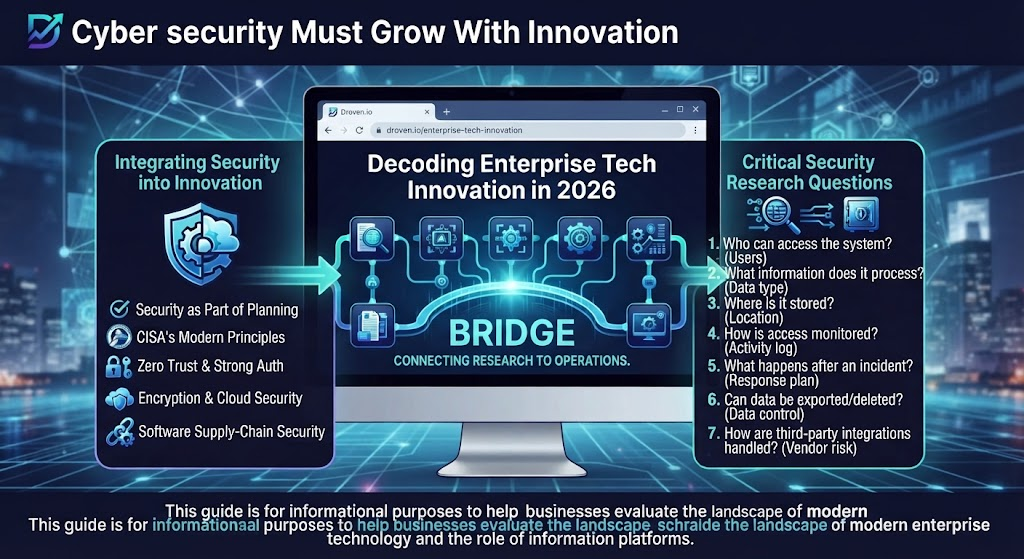
Cybersecurity should therefore become part of technology planning rather than an afterthought. CISA’s guidance includes zero-trust principles, stronger authentication, encryption, cloud security, and software supply-chain security as important parts of modern cybersecurity planning.
For enterprise technology research, security questions should include:
- Who can access the system?
- What information does it process?
- Where is the information stored?
- How is access monitored?
- What happens after a security incident?
- Can the organization export or delete its data?
- How does the vendor handle third-party integrations?
Data Analytics and Better Business Decisions
Modern organizations generate data through websites, applications, sales systems, customer interactions, devices, and internal operations.
Data analytics helps convert this information into useful measurements. A company might analyze sales trends, customer behavior, inventory, employee workflows, website performance, or operational costs.
The value comes from connecting analysis to an actual business question. A dashboard with hundreds of numbers is less useful than a focused system that helps a team identify a problem and take the right operational action.
Digital Transformation Is More Than Buying New Software
Digital transformation often fails when businesses treat it as a shopping exercise.
Buying new software does not automatically improve an inefficient process. Before selecting a technology, organizations should understand the existing workflow, identify unnecessary steps, define the desired outcome, and determine how employees will use the new system.
This makes droven.io enterprise tech innovation more useful as a research concept than as a product label. Readers can explore technology categories first and then evaluate specific solutions based on their own requirements.
How Enterprises Can Evaluate a Technology
A practical evaluation should cover business value, technical fit, security, cost, integration, and long-term maintenance.
| Evaluation area | Questions to ask |
| Business need | What problem does the technology solve? |
| Expected value | What measurable result should it produce? |
| Integration | Can it connect with current systems? |
| Security | What protections are available? |
| Privacy | How is sensitive data handled? |
| Scalability | Can the system support future growth? |
| Reliability | What happens during outages? |
| Cost | What is the total cost of ownership? |
| Skills | Does the team have the required expertise? |
| Governance | Who controls access and usage? |
| Maintenance | Who manages updates and fixes? |
| Exit strategy | Can data be exported if the business changes providers? |
Google’s cloud architecture guidance similarly emphasizes security, reliability, performance, cost, operational management, and sustainability when designing cloud environments.
Benefits of Researching Enterprise Technology Through Droven.io
A technology information platform can be useful during the early research stage.
Potential benefits include:
- Learning unfamiliar technology terms
- Understanding emerging technology categories
- Discovering possible business use cases
- Following developments in AI and software
- Building questions for vendors
- Comparing different technology approaches
- Helping non-technical teams understand technical subjects
The key is to use editorial content as a starting point rather than treating one article as the final authority for a major technology purchase.
What Are the Limitations?
Readers should also understand what technology articles cannot replace.
An article may explain how a technology works, but it cannot automatically confirm whether a specific product meets a company’s security, compliance, performance, or integration requirements.
For important decisions, verify claims using primary documentation, vendor security materials, technical specifications, recognized standards, contracts, and testing.
NIST’s AI Risk Management Framework, for example, is designed to help organizations identify and manage AI risks while considering characteristics such as reliability, security, transparency, privacy, and fairness.
How to Use Droven.io for Enterprise Technology Research
A simple research workflow can make technology content more useful.
Step 1: Define the problem
Start with the business problem rather than the technology name.
Step 2: Learn the category
Use technology articles to understand terminology, capabilities, and common use cases.
Step 3: Identify possible solutions
Create a shortlist of technologies that could address the problem.
Step 4: Verify primary information
Check official documentation, security information, pricing, technical specifications, and compliance materials.
Step 5: Test before scaling
Run a small pilot whenever practical. Measure real performance rather than relying only on marketing claims.
Step 6: Review the results
Compare the project against the original business goal. Keep, change, or stop the implementation based on measurable evidence.
Droven.io Enterprise Tech Innovation vs Enterprise Technology
These terms are related but should not be treated as identical.
| Factor | Droven.io enterprise tech innovation | Enterprise technology |
| Meaning | Technology research and editorial topic | Technology used inside organizations |
| Main role | Education and information | Business operations |
| Examples | AI articles, automation explainers, technology guides | AI systems, cloud platforms, databases |
| Deployment | Not presented as a standard enterprise deployment platform | Depends on the selected technology |
| Users | Readers, researchers, technology learners | Employees, developers, IT teams |
| Decision stage | Research and learning | Evaluation, implementation, operation |
This distinction prevents a common misunderstanding: an article about an enterprise technology is not the same thing as the technology itself.
How AI Governance Fits Into Enterprise Innovation
AI adoption creates additional governance questions because AI systems can affect customers, employees, business decisions, and sensitive information.
NIST’s Generative AI Profile provides guidance for identifying, measuring, and managing risks associated with generative AI across its lifecycle.
A practical governance plan can include:
- Approved AI tools
- Data-use rules
- Access permissions
- Human review
- Testing procedures
- Monitoring
- Incident reporting
- Vendor assessment
- Documentation
- Periodic risk reviews
This approach allows organizations to explore innovation while maintaining control over how technology is used.
Who Can Benefit From This Technology Research?
Droven.io enterprise tech innovation can be relevant to several groups during the research stage.
Business owners
Business owners can learn how new technology may solve operational problems without needing deep technical knowledge.
IT teams
IT professionals can use technology coverage to discover concepts and identify areas that require deeper technical research.
Developers
Developers can explore emerging software, AI, cloud, and automation concepts before reviewing detailed documentation.
Students
Students can use enterprise technology topics to build foundational knowledge about modern digital systems.
Managers
Managers can use technology research to prepare questions for vendors, technical teams, and procurement departments.
Trust Signals and Responsible Research
Technology information becomes more useful when readers can distinguish facts from promotional claims.
Before trusting a technology claim, check:
- Who published the information?
- Is the author identified?
- Is the publication date clear?
- Does the article cite primary sources?
- Can technical claims be verified?
- Does the vendor provide official documentation?
- Are security and privacy details available?
- Is the information still current?
For AI-related decisions, NIST provides an authoritative reference through its AI Risk Management Framework and related resources.
For cloud architecture, Google’s Well-Architected Framework provides current technical guidance covering security, reliability, performance, cost, operations, and sustainability.
What Does the Future of Enterprise Tech Innovation Look Like?
Enterprise technology is moving toward increasingly connected systems. AI can work with business data, cloud platforms can provide the infrastructure, automation can execute workflows, and analytics can measure results.
This does not mean every organization needs every new technology. A better approach is to connect technology investment to a clearly defined business problem and then measure whether the solution produces the intended result.
That principle keeps innovation practical. Technology should support people and business goals rather than become a goal by itself.
Frequently Asked Questions
Short answer: It refers to the connection between Droven.io’s technology coverage and the broader use of AI, automation, cloud computing, cybersecurity, analytics, and software innovation in businesses.
Short answer: Current public information describes Droven.io primarily as an editorial or informational technology platform rather than a conventional enterprise software product.
Short answer: Public descriptions associate the platform with AI, machine learning, automation, cybersecurity, cloud computing, software development, startups, robotics, and emerging technology.
Short answer: Yes. Businesses can use technology articles for early research and education, then verify important technical, security, compliance, and pricing claims through primary sources.
Short answer: AI can help organizations analyze information, automate repetitive work, support customer service, generate content, assist developers, and improve selected decision-making processes.
Short answer: Businesses should evaluate the problem being solved, expected value, integration, security, privacy, scalability, reliability, total cost, governance, and ongoing maintenance.
Conclusion
Droven.io enterprise tech innovation is best understood as a research topic connecting Droven.io’s technology-focused publishing with the wider world of enterprise technology. Current public information points to Droven.io primarily as an editorial technology platform, not a conventional enterprise software product.
For businesses, the most useful path is practical: understand the technology, define a real business problem, verify information through authoritative sources, test the solution, and measure the results. Whether the subject is AI, cloud computing, automation, cybersecurity, analytics, or software development, informed research can help teams make technology decisions based on evidence rather than hype.